A few days back, Amy asked us to post our lacto-fermented salsa recipe. We use the basic outline of the recipe from Nourishing Traditions and tweak it a bit based on which fresh ingredients we have available at the time. Sometimes it has more bell peppers than other times, sometimes it has cilantro, sometimes not. We have found though, that a key to making it really yummy is to dice the veggies very small, so that you get a blending of all the flavors in each bite. The following recipe is for making one quart, but the process of skinning the tomatoes dirties a lot of dishes in our opinion, so we don't bother making less than a dozen quarts at a time. (More bang for the same amount of mess, you know.) The real key to deciding how much to make is how much refrigerator space you have, because that is where the salsa will live after fermenting, not in the pantry.
4 medium tomatoes, peeled, seeded and diced (you want about three cups worth)
2 small onions, finely chopped
finely chopped bell peppers of any color to taste (we use roughly 1/4 of a pepper per quart)
6-8 cloves fresh garlic, peeled and minced
1/4 bunch cilantro, chopped
1/4 cup lemon juice
1 Tablespoon sea salt (Do not skimp here! This is the key to getting the bad bacteria to not grow while waiting for the lactic acid preservation to complete!)
4 Tablespoons whey (not powdered, use only the real stuff - you know, the watery stuff that is sometimes in yogurt) [Note: if you don't have this available, use an additional 1 Tablespoon of sea salt, for a total of 2 Tbsp. per quart]
filtered water
Optional: Finely chopped hot peppers to taste. We have used jalapenos, chilies, etc. Use what you have available, and go easy until you see how the peppers react to lacto-fermenting. Some seem to get spicier.
Here's what you do:
Peel the tomatoes. (Google instructions if you have never done it before.) Chop all the veggies, then mix all veggies into a large bowl along with the lemon juice. We then fill each jar with the veggie and lemon juice mixture, leaving a full 1.5 inch headspace above the tops of the veggies. Smush the veggies down lightly with something non-metal (your fingers, a wooden spoon, a plastic spatula, etc.). On the top of the veggie mixture, add your sea salt, whey (remember: extra salt if you don't have this), and filtered water to bring the total volume up to 1 inch below the top of your jar. (Tip: Often you will not need to add any water; the volume will already be high enough.) Cover the jar tightly and shake until the sea salt is dissolved and thouhroughly incorporated into the jar contents. Set them on the counter, and leave at room temperature for about 48 hours. When the time is up, transfer jars to cold storage(i.e. your fridge). Try them after they are cool! The flavors will blend more, and mature after more time in cold storage, but this salsa is also delicious immediately!
Now, go get some Green Mountain Gringo chips (or make your own if you are ambitious) and dig in!
Also, I just came across this other recipe for Lacto-Fermented Salsa last week.
Enjoy!
Showing posts with label Healthy Living. Show all posts
Showing posts with label Healthy Living. Show all posts
Tuesday, June 23, 2009

Friday, November 28, 2008
Nursing Mommas and Dietary Oils
I was asked by a friend (several weeks ago - blush) about hydrogenated oils, and why I avoid them especially when nursing. Her comments were:
I kept putting off answering this until I had some time to do a little research and post links, etc., but realize that may not happen for some time still. But it is an interesting subject to Google should you be interested, and anyone can do it (Google stuff, that is). The basic gist is that hydrogenated oils, partially hydrogenated oils and trans fats all have a deleterious effect on breastmilk - production and the actual constitution of the milk.
What I'll do instead is just answer the basic questions and share our experience. :)
When I first started learning about oils, which ones are health-supporting and which ones are not, I could not afford to just change everything we did overnight. Firstly, I did not know how, secondly, it would cost too much and be wasteful of what we had on hand. So, like every other change we made in our diet and lifestyle, when something ran out, we replaced it with something better... never to go back except in an emergency. When the canola oil ran out, (that the media had told me was so good for us), I bought extra virgin olive oil. When the margarine was gone, I started buying real butter and have not looked back.
It was more expensive to replace the bad stuff with the good stuff, but we squeezed money from somewhere else to make it work. We purposely canceled our health insurance policy and used the money to add to our grocery budget and to learn about our health. We also changed around how we shopped by buying in huge quantities in order to save more money to put into healthier ingredients.
Now, we only use three main things as oils for cooking. I use extra virgin olive oil for anything raw like mayonnaise or salad dressings (because it is unstable when heated). I use coconut oil and butter for cooked foods. Coconut oil is very stable at high temperatures, so it is what I use for anything fried. I also use coconut oil for most things that call for shortening. Pie crusts turn out best for me with butter, though. I buy the coconut oil in 5 gallon buckets, too. With grocery prices going up so much recently, I stepped back to expeller-pressed coconut oil (a lot cheaper) instead of the virgin coconut oil that I had been buying, because it was going to overly stress my grocery budget. I purchase butter 36 pounds at a time from a local food co-op.
We do not use lard (pork fat) at all because it is not part of what YHWH has called food for us. Trust and obey... for there is no other way, right?
We make our own bread (gotta love that Zojirushi!) and use either butter or coconut oil in our bread recipe. The coconut oil seems to make the bread keep a bit longer, too.
Peanut butter is a tough one. We use it a ton, too, but I do not think I have it in me at this time to actually make it. (I have to be honest and admit that it never crossed my mind before.) Too many other irons in the fire, I guess. What we have done in the past is buy 5 pound containers of peanut butter whose only ingredients are peanuts and salt from our food co-op. That is a great plan if you really want to cut back on usage, because it does not taste as good (at least to us). A better plan that actually works out to be very close in cost is to buy Smuckers brand natural peanut butter from the grocery store. If you have a Trader Joes nearby, they also have a good price on healthy peanut butter. If the cost is still an issue, spread really thin. :)
[EDIT: Be sure to check the comments below, where Amy tells us how she makes peanut butter from scratch with just a food processor!]
So, I hope that helps. I'd be happy to help with more questions, too, if you need!
Since I read your follow-up to my comment on your twinsI have been researching hydrogenated oils and their effect on breast milk and our bodies. I guess this is a little new to me as I haven’t really thought or heard much about this before, but I am very glad you brought it to my attention. (I am kind of ashamed that I haven’t been awakened to it sooner as I try to be reasonably attuned to our nutritional needs, but I don’t normally do a lot of researching in this area). I intend to make some changes right away. I think it will be tough in some ways, though…I mean, we go through a LOT of peanut butter and I don’t know if it is reasonable to think that we could just start making our own since we don’t even have the equipment to do so…(what do you do? Do you have a grain mill and an attachment to make your own p-nut butter?) What do you use for cooking oils? I read here that canola, corn, and safflower oils should be avoided, so I am curious about how you do it and would appreciate your input to help me get started, when you have time. Do you use coconut oil? I purchase 50# pails of it for my soap making business, but have never once used it for cooking (although it is food grade). Do you use lard in place of shortening? Do you make your own bread, and if so, what do you use for the oil? We actually sell a lot of honey wheat bread since my oldest dd has gotten quite proficient at it, and we took it to sell at our local farm market every Saturday this summer. I’m realizing that perhaps my baby’s birth weight was noticeably lower so that I would come to learn about this nutritional concern for our family. But if you have any links to share or helpful info, esp. on how you do it. I’d love to hear it!
I kept putting off answering this until I had some time to do a little research and post links, etc., but realize that may not happen for some time still. But it is an interesting subject to Google should you be interested, and anyone can do it (Google stuff, that is). The basic gist is that hydrogenated oils, partially hydrogenated oils and trans fats all have a deleterious effect on breastmilk - production and the actual constitution of the milk.
What I'll do instead is just answer the basic questions and share our experience. :)
When I first started learning about oils, which ones are health-supporting and which ones are not, I could not afford to just change everything we did overnight. Firstly, I did not know how, secondly, it would cost too much and be wasteful of what we had on hand. So, like every other change we made in our diet and lifestyle, when something ran out, we replaced it with something better... never to go back except in an emergency. When the canola oil ran out, (that the media had told me was so good for us), I bought extra virgin olive oil. When the margarine was gone, I started buying real butter and have not looked back.
It was more expensive to replace the bad stuff with the good stuff, but we squeezed money from somewhere else to make it work. We purposely canceled our health insurance policy and used the money to add to our grocery budget and to learn about our health. We also changed around how we shopped by buying in huge quantities in order to save more money to put into healthier ingredients.
Now, we only use three main things as oils for cooking. I use extra virgin olive oil for anything raw like mayonnaise or salad dressings (because it is unstable when heated). I use coconut oil and butter for cooked foods. Coconut oil is very stable at high temperatures, so it is what I use for anything fried. I also use coconut oil for most things that call for shortening. Pie crusts turn out best for me with butter, though. I buy the coconut oil in 5 gallon buckets, too. With grocery prices going up so much recently, I stepped back to expeller-pressed coconut oil (a lot cheaper) instead of the virgin coconut oil that I had been buying, because it was going to overly stress my grocery budget. I purchase butter 36 pounds at a time from a local food co-op.
We do not use lard (pork fat) at all because it is not part of what YHWH has called food for us. Trust and obey... for there is no other way, right?
We make our own bread (gotta love that Zojirushi!) and use either butter or coconut oil in our bread recipe. The coconut oil seems to make the bread keep a bit longer, too.
Peanut butter is a tough one. We use it a ton, too, but I do not think I have it in me at this time to actually make it. (I have to be honest and admit that it never crossed my mind before.) Too many other irons in the fire, I guess. What we have done in the past is buy 5 pound containers of peanut butter whose only ingredients are peanuts and salt from our food co-op. That is a great plan if you really want to cut back on usage, because it does not taste as good (at least to us). A better plan that actually works out to be very close in cost is to buy Smuckers brand natural peanut butter from the grocery store. If you have a Trader Joes nearby, they also have a good price on healthy peanut butter. If the cost is still an issue, spread really thin. :)
[EDIT: Be sure to check the comments below, where Amy tells us how she makes peanut butter from scratch with just a food processor!]
So, I hope that helps. I'd be happy to help with more questions, too, if you need!
Thursday, November 13, 2008
Eating Fresh On A Two-Week Grocery Plan
When folks hear that I do our grocery shopping every six to eight weeks, they are often flabbergasted. Without exception, their first gasping question is always, "How do you have fresh produce?", as if it were the Holy Grail of feeding a family. Granted, fresh produce is very healthy for us. Even conventionally grown, non-organic, pesticide-laden produce has produced good results in scientific studies. It is what was used in all the studies showing that eating enough fresh fruits and vegetables can help reduce risks of cancer and other disease. (Remember Five-A-Day?)
While I concede that the ideal situation would be to live in the garden of Eden, or as a distant second, to have our own backyard gardens with seasonal produce ripe for the harvesting four seasons of the year, ideals are rarely reality. Having our own garden supply all our produce needs for the year is our goal, but we are not there yet, and something must be done in the mean time.
Although I am about to share my plan for how to eat fresh produce without living at the grocery store, I would like to state for the record that having fresh produce all year 'round is not an inalienable right. It is simply a blessing that we have in this country - a blessing for which I am grateful.
On to the plan. Every six to eight weeks, depending on how much is going on in life, or how much company we have had, we do our stock-up grocery shopping trip. This is where I refill the pantry and freezer with any frozen fruits and vegetables and shelf-stable items like canned goods. Once a month our health food co-op delivers our meats, grains, beans and baking supplies. That just leaves the fresh produce to pick up every two weeks, which for us, looks like Mr. Visionary making a stop on his way home from work.
We shop this way because it keeps us out of the stores more (so no impulse buying), it saves trips to town (so saving time, gas and stress) and it forces frugality (we make do with what we have on hand). It is not brilliant, it is just a fruit of planning ahead.
During the first week, we focus on the fresh produce that goes bad the fastest. This is the time to eat lettuce and bananas. During the second week, we focus on the fresh things that keep a bit longer like apples and carrots. We rotate the produce we eat seasonally, to take advantage of what is in abundant supply and cheaper during each season. That means we rarely eat fresh tomatoes and watermelon in January (they taste yucky then anyway), but instead focus on the citrus fruits, leafy greens and root vegetables that are in season. We only have pomegranates in October and November, but enjoy them fully and often while they are in season and actually affordable. Two great books that discuss eating this way are Simply In Season and Animal, Vegetable, Miracle .
Week One Produce:
Lettuces, berries, avocados, pomegranate, bananas, peaches, tomatoes, pineapple, spinach, pears, kiwi, etc.
Week Two Produce:
Carrots, celery, potatoes, cabbage, green peppers, apples, oranges, sweet potatoes, beets, turnips, refrigerated bananas (put them in the fridge during week one- they will turn black on the outside, but still be white and fresh on the inside), leafy greens like collards and kale, and romaine lettuce usually keeps well in the second week, too.
Week two can also be supplemented with frozen fruits, since they are not blanched, and are still raw. We use frozen fruit in smoothies and mixed in our yogurt. The children also like frozen banana slices with peanut butter on top as an afternoon snack.
Both weeks we supplement with lots of lacto-fermented vegetables, which are not 'fresh', but they are raw. Each week can also be supplemented with fresh sprouts grown on your kitchen counter. Alfalfa sprouts, while popular, are not good for you, so we like to make mung bean sprouts (the kind used in oriental food a lot). My kids love these lightly sauteed in butter with a sprinkle of soy sauce. They are crunchy, yummy...and fresh.
So, that is how we do it. My goal as a Mommy Chef is to serve something fresh or raw three times a day, and this is the best way I have come up with to pull it off so far. If you have other tips, I'd love to hear them!
While I concede that the ideal situation would be to live in the garden of Eden, or as a distant second, to have our own backyard gardens with seasonal produce ripe for the harvesting four seasons of the year, ideals are rarely reality. Having our own garden supply all our produce needs for the year is our goal, but we are not there yet, and something must be done in the mean time.
Although I am about to share my plan for how to eat fresh produce without living at the grocery store, I would like to state for the record that having fresh produce all year 'round is not an inalienable right. It is simply a blessing that we have in this country - a blessing for which I am grateful.
On to the plan. Every six to eight weeks, depending on how much is going on in life, or how much company we have had, we do our stock-up grocery shopping trip. This is where I refill the pantry and freezer with any frozen fruits and vegetables and shelf-stable items like canned goods. Once a month our health food co-op delivers our meats, grains, beans and baking supplies. That just leaves the fresh produce to pick up every two weeks, which for us, looks like Mr. Visionary making a stop on his way home from work.
We shop this way because it keeps us out of the stores more (so no impulse buying), it saves trips to town (so saving time, gas and stress) and it forces frugality (we make do with what we have on hand). It is not brilliant, it is just a fruit of planning ahead.
During the first week, we focus on the fresh produce that goes bad the fastest. This is the time to eat lettuce and bananas. During the second week, we focus on the fresh things that keep a bit longer like apples and carrots. We rotate the produce we eat seasonally, to take advantage of what is in abundant supply and cheaper during each season. That means we rarely eat fresh tomatoes and watermelon in January (they taste yucky then anyway), but instead focus on the citrus fruits, leafy greens and root vegetables that are in season. We only have pomegranates in October and November, but enjoy them fully and often while they are in season and actually affordable. Two great books that discuss eating this way are Simply In Season and Animal, Vegetable, Miracle .
Week One Produce:
Lettuces, berries, avocados, pomegranate, bananas, peaches, tomatoes, pineapple, spinach, pears, kiwi, etc.
Week Two Produce:
Carrots, celery, potatoes, cabbage, green peppers, apples, oranges, sweet potatoes, beets, turnips, refrigerated bananas (put them in the fridge during week one- they will turn black on the outside, but still be white and fresh on the inside), leafy greens like collards and kale, and romaine lettuce usually keeps well in the second week, too.
Week two can also be supplemented with frozen fruits, since they are not blanched, and are still raw. We use frozen fruit in smoothies and mixed in our yogurt. The children also like frozen banana slices with peanut butter on top as an afternoon snack.
Both weeks we supplement with lots of lacto-fermented vegetables, which are not 'fresh', but they are raw. Each week can also be supplemented with fresh sprouts grown on your kitchen counter. Alfalfa sprouts, while popular, are not good for you, so we like to make mung bean sprouts (the kind used in oriental food a lot). My kids love these lightly sauteed in butter with a sprinkle of soy sauce. They are crunchy, yummy...and fresh.
So, that is how we do it. My goal as a Mommy Chef is to serve something fresh or raw three times a day, and this is the best way I have come up with to pull it off so far. If you have other tips, I'd love to hear them!
Wednesday, November 12, 2008
Free Health Books
I came across these books online several months ago, but unfortunately didn't print them, then the link where I found them went bad. They are available as free downloads, and this time, I really will print them. I'm sharing the link in case you could use them, too. We never can tell when they may be necessary.
Wednesday, October 8, 2008
How Not To Celebrate Rosh Hashana
The feast days of YHWH often leave me with profound lessons about the Messiah and insight into His plans for us. This year, however, my lessons from Yom Teruah (Rosh Hashana) were of a more practical nature.
My currently having nine sick children and one very sick husband compel me to offer this advice. On the Feast of Trumpets (Rosh Hashana) , when observing the command to blow the trumpet:
DO NOT SHARE THE SHOFAR!
Next year, Yah willing, we will have one designated shofar-blower. And we'll disinfect the thing when it's over. I'm just sayin'.

My currently having nine sick children and one very sick husband compel me to offer this advice. On the Feast of Trumpets (Rosh Hashana) , when observing the command to blow the trumpet:
DO NOT SHARE THE SHOFAR!
Next year, Yah willing, we will have one designated shofar-blower. And we'll disinfect the thing when it's over. I'm just sayin'.
Wednesday, July 23, 2008
Encouraging News
There are many factors to which I could attribute the good news: a healthy diet, plenty of rest, good hydration, those wonderful homemade vitamins, the blessing of midwifery care, or a host of other miscellaneous factors. My heart tells me, however that there is only one factor in the end. Yahweh has been merciful to me, and His grace is abundant.
Yesterday's ultrasound showed that our babies are 5lb 3oz, and 6lb 6 oz at 34.5 weeks. Do the math if you would like, or take my word that it is a lot of baby to be carrying around. At this stage, they usually put on about a half pound per week each, but I'm trying not to think of all that. Add in the extra two pounds for two placentas, and I don't wonder at my being so tired... or my walking like a duck... a barefooted duck on sharp gravel, even.
I am weary of waiting, but eager to have these babies "cook" as long as possible. When I am exhausted, and wanting labor to begin (but feeling guilty because it is too soon), the only comfort I have is knowing with a certainty that Yahweh is in control. I was reminded of this anew last night, as my sister in law was rushed to the hospital for an emergency c-section because of toxemia. He declared the end from the beginning, and He himself knit these little ones together in my womb.
The timing is all His. I was sure last night that I would have accidentally started labor because of stress, but it was not to be. You see, as I was resting, and looking out the window, a full sized black bear just walked by my window. While my boys were outside playing in the yard. I ran to the door, screamed for the boys, then almost fainted when they walked casually in mentioning that the bear was only 12 feet from them.
I don't have a lot of experience with bears (read that NONE), and never thought I'd need it where we live (we are not that rural, you know). But, as a shameless plug for homeschooling, my kids educated me after the fact that black bears aren't dangerous if you just stay out of their way. They found this out on their own just from reading all the field guides we have laying around. If they were in "school" all day, they never would have had time to educate themselves or their Mom on this important matter.
So, let the record show that I can now scratch off of the list black bears walking through the front yard as a possible means of starting labor. Now we know.
I'll keep you posted on any new developments... or anything else we can scratch off said list.

Yesterday's ultrasound showed that our babies are 5lb 3oz, and 6lb 6 oz at 34.5 weeks. Do the math if you would like, or take my word that it is a lot of baby to be carrying around. At this stage, they usually put on about a half pound per week each, but I'm trying not to think of all that. Add in the extra two pounds for two placentas, and I don't wonder at my being so tired... or my walking like a duck... a barefooted duck on sharp gravel, even.
I am weary of waiting, but eager to have these babies "cook" as long as possible. When I am exhausted, and wanting labor to begin (but feeling guilty because it is too soon), the only comfort I have is knowing with a certainty that Yahweh is in control. I was reminded of this anew last night, as my sister in law was rushed to the hospital for an emergency c-section because of toxemia. He declared the end from the beginning, and He himself knit these little ones together in my womb.
The timing is all His. I was sure last night that I would have accidentally started labor because of stress, but it was not to be. You see, as I was resting, and looking out the window, a full sized black bear just walked by my window. While my boys were outside playing in the yard. I ran to the door, screamed for the boys, then almost fainted when they walked casually in mentioning that the bear was only 12 feet from them.
I don't have a lot of experience with bears (read that NONE), and never thought I'd need it where we live (we are not that rural, you know). But, as a shameless plug for homeschooling, my kids educated me after the fact that black bears aren't dangerous if you just stay out of their way. They found this out on their own just from reading all the field guides we have laying around. If they were in "school" all day, they never would have had time to educate themselves or their Mom on this important matter.
So, let the record show that I can now scratch off of the list black bears walking through the front yard as a possible means of starting labor. Now we know.
I'll keep you posted on any new developments... or anything else we can scratch off said list.
My sister in law & Me comparing belly sizes. She was 36 weeks here, and I was 32 weeks.
Bill & Tracy, Congratulations on a beautiful baby girl! You done good, Momma!
Friday, April 4, 2008
Yummy Homemade Toothpaste!
If you are like me and use flouride-free toothpaste without SLS and other yucky ingredients, you are likely paying a lot for toothpaste. Any of the brands we have found that meet the criteria we are looking for cost about $5.00 per tube, for a not-so-family-sized tube. (If you don't understand why someone would want toothpaste without flouride, then you may want to do some homework on your own. When I found out that Sweden, Norway, Denmark, Germany, Italy, Belgium, Austria, France and The Netherlands have banned fluoride, I figured it was something worth looking into. Here are a few articles to get you started: Weston A. Price Foundation articles and Dr. Mercola's site .)
Because I have beenfocused obsessed with "bringing back home" (making/creating/growing our own or even eliminating our "need") all the items that I reasonably can, and our family has been making concerted efforts to end our own consumerism, I was intrigued to find instructions for making your own toothpaste on the MOMYS digest. The fact that it is potentially cheaper is also a bonus, although I haven't yet crunched the numbers.
Here's the recipe I used~
Mix together:
~2 Tablespoons of Coconut Oil (I buy this from Mountain Rose Herbs - $121 for a 5-gallon bucket.)
~3 Tablespoons of Baking Soda
~5 drops Peppermint Essential oil
~5 drops Spearmint Essential Oil
~a pinch of Stevia powder
I have used baking soda to brush my teeth before (and felt a bit like a martyr because the taste was less-than-desirable), but this was incredible! I am so thrilled at how well it turned out! The coconut oil gives it a creamy consistency, and holds the Baking Soda together, while the Stevia and essential oils gives it a yummy flavor. (I chose to use part Spearmint instead of all Peppermint because the Spearmint doesn't have that "hot" mouth feel that Peppermint does. This is important to little people!) Note: I feel safe allowing these essential oils to be used in a situation where they could possibly be ingested because 1) the amounts are so small, and 2) both Spearmint and Peppermint essential oils are on the FDA's GRAS (generally recognized as safe) list.
It doesn't have that foamy effect that commercial toothpaste has, but I actually appreciate that - it doesn't get the bathroom sink so dirty, and it doesn't gag this pregnant woman like the foamy kind does. I was amazed at how well it turned out, but the best part was how quick it was to mix together. It literally took less than five minutes including the time it took to gather the oils from another room. Our stores change brands of toothpaste so quickly, that I couldn't have picked out toothpaste in the store as quickly as that because of reading labels. We mixed it in a tiny wide mouth half-pint canning jar, and just dip dry toothbrushes in it. Don't get grossed out... remember coconut oil is anti-viral, anti-bacterial and anti-fungal, so it will even keep the toothbrushes more sanitary.
This business of bringing stuff back home is so much fun!
Because I have been
Here's the recipe I used~
Mix together:
~2 Tablespoons of Coconut Oil (I buy this from Mountain Rose Herbs - $121 for a 5-gallon bucket.)
~3 Tablespoons of Baking Soda
~5 drops Peppermint Essential oil
~5 drops Spearmint Essential Oil
~a pinch of Stevia powder
I have used baking soda to brush my teeth before (and felt a bit like a martyr because the taste was less-than-desirable), but this was incredible! I am so thrilled at how well it turned out! The coconut oil gives it a creamy consistency, and holds the Baking Soda together, while the Stevia and essential oils gives it a yummy flavor. (I chose to use part Spearmint instead of all Peppermint because the Spearmint doesn't have that "hot" mouth feel that Peppermint does. This is important to little people!) Note: I feel safe allowing these essential oils to be used in a situation where they could possibly be ingested because 1) the amounts are so small, and 2) both Spearmint and Peppermint essential oils are on the FDA's GRAS (generally recognized as safe) list.
It doesn't have that foamy effect that commercial toothpaste has, but I actually appreciate that - it doesn't get the bathroom sink so dirty, and it doesn't gag this pregnant woman like the foamy kind does. I was amazed at how well it turned out, but the best part was how quick it was to mix together. It literally took less than five minutes including the time it took to gather the oils from another room. Our stores change brands of toothpaste so quickly, that I couldn't have picked out toothpaste in the store as quickly as that because of reading labels. We mixed it in a tiny wide mouth half-pint canning jar, and just dip dry toothbrushes in it. Don't get grossed out... remember coconut oil is anti-viral, anti-bacterial and anti-fungal, so it will even keep the toothbrushes more sanitary.
This business of bringing stuff back home is so much fun!
Thursday, April 3, 2008
Homemade Prenatal Vitamins
I stopped taking prenatal vitamins a few pregnancies ago because I don't really feel comfortable with singled-out vitamins (out of their naturally occurring form, i.e. "food"). I looked around for a natural supplement as well, reading lots of ingredient lists and testimonials, but I either didn't like the company well enough to buy from them, or they included ingredients I felt would be harmful, so I struck out on that front as well.
As I was researching and making my personal list of what *I* would put in a prenatal supplement, if *I* were a manufacturer, it hit me that I had access to each of the ingredients. I could just purchase the bulk ingredients and make my own capsules. Eureka! So that is exactly what I did. Now, the disclaimer is that these may not be *your* list of what to put in a prenatal supplement, or any particular expert's list, but they covered my bases.
Here is what was on my list:
Alfalfa ~ Loaded with vitamins A, D, E and K, eight digestive enzymes, and numerous trace minerals. It is particularly helpful in late pregnancy because the vitamin K it supplies promotes proper blood clotting, thereby reducing the risk of postpartum hemorrhage.
Bee Pollen ~ contains more than 96 different nutrients, including every single nutrient that is needed to sustain human life. It is made up of 40% protein, nearly all of it usable by the body without any further breakdown or metabolism. Nourishing Traditions calls it a "super food".
Beet Root Powder ~ Beet root is a good source of minerals, particularly easy-to-assimilate iron. Beet root is also helpful in the digestion of fats, gallbladder infections, digestive problems, anemia, and for toning and rebuilding the liver. Contains beta-carotene, calcium, magnesium, vitamin B1 (thiamine), vitamin B5 (pantothenic acid), phosphorus, potassium, selenium, tryptophan, vitamin C, zinc and soluble and insoluble fiber and spleen function improvement.
Bull Kelp (Nereocystis Leutkeana) ~ excellent source of vitamins A, B's (especially B12), C, D, E and K as well as essential fatty acids. High in iron and chlorophyl as well as a wealth of other minerals like potassium, sodium, calcium, iodine, magnesium, sulfur, nitrogen, zinc, boron, copper, manganese, chromium, selenium, bromine, vanadium, and nickel.
Milk Thistle Seed ~ Milk thistle extract may protect the cells of the liver by blocking the entrance of harmful toxins and helping remove these toxins from the liver cells. Shonda Parker says this is the best supportive supplement for the liver in her opinion.
Norwegian Kelp (Ascophyllum Nodosum) ~ excellent source of vitamins A, B's (especially B12), C, D, E and K as well as essential fatty acids. High in iron and chlorophyl as well as a wealth of other minerals like potassium, sodium, calcium, iodine, magnesium, sulfur, nitrogen, zinc, boron, copper, manganese, chromium, selenium, bromine, vanadium, and nickel. Kelp as a source of iodine assists in making thyroid hormones, which are necessary for maintaining normal metabolism in all cells of the body. The U.S. population in general has shown a trend of significantly decreasing iodine intake, and I take it because we do not use iodized salt.
Oatstraw ~ Calcium and magnesium rich, has silica, fiber, and trace nutrients. Also contains phosphorus and vitamins A, B1, B2 and E. Oats and oat straw help strengthen the nervous system and are considered nerve tonics. Rich in minerals, oats and oat straw also help build strong bones and teeth and strengthen capillaries and veins, and provides some support to those troubled by varicose veins and hemorrhoids.
Red Raspberry Leaf ~ tones the uterus and helps prevent miscarriage and postpartum hemorrhage from a relaxed or atonic uterus; rich in calcium, magnesium, iron, phosphorus, potassium and vitamins B, C and E. This is the most frequently used herb for pregnancy, and has a long track record of benefit to the female organs.
Spirulina ~ Contains rich vegetable protein (60~ 63 %, 3~4 times higher than fish or beef ), multi Vitamins (Vitamin B 12 is 3~4 times higher than animal liver and is the best vegetable source of B12) and is rich in folic acid. It contains a wide range of minerals (including Iron, Potassium, Magnesium Sodium, Phosphorus, Calcium etc.), a high volume of Beta- carotene which protects cells (5 time more than carrots, 40 time more than spinach), high volumes of gamma-Linolein acid (which can reduce cholesterol and prevent heart disease).
After acquiring my ingredients, I powdered them all well in my blender. (Most of them I was able to buy already in powder form.) After they were all sufficiently powdered (small enough to fit easily into a capsule without hanging out over the edges), I mixed them well in a large bowl in the amounts I had planned. Measuring by weight, I added equal parts of everything listed above, with the exception of only a quarter part of the Bull Kelp. Next I began to make them into capsules.
(Are you as tickled as I am to realize that this is something we can make at home?)
Here is a basic photo tutorial of how to make the capsules from the company from which I bought the capsule maker and the ingredients. It really is very easy, and most of my Bigs (the older children) can do it alone, without any supervision. Even the younger children can "help Mom make vitamins for the baby" - they have so much fun! I keep the already-made capsules in a bottle with a (supposedly) child-proof cap, and the rest of the herbal mixture in a tightly sealed glass jar in the freezer. I only make enough capsules for about two weeks at a time, so I can keep the rest of the ingredients as fresh as possible.
I am really impressed with how much better I feel since beginning this supplement! My midwife is also thrilled with them, and has asked me to make them in bulk and sell them to her other patients. I don't really foresee that happening anytime soon, but it encouraged me that I was on the right track, anyway. OK, another disclaimer: surely you know that I am no doctor, other than a Dr. Mom. So, do your own homework, check with your own practitioner, etc, etc, bla bla, bla before you go taking advice from some stranger (namely Me) on the internet.
I also made my own herbal tincture as an iron supplement to help with my anemia, and these are the ingredients I added to it:
Dandelion Roots & Leaves ~ Both have tons of vitamins A and C, iron, calcium, potassium, folic acid, and many trace elements. The root is a specific remedy for the liver (remember, pregnancy is very hard on the liver). The leaf is a mild diuretic, which can reduce water retention during pregnancy - but...without depleting potassium stores like most diuretics.
Nettles ~ Vitamins A, C, D and K (which will increase blood's clotting ability and increases available hemoglobin, both of which decrease the likelihood of postpartum hemorrhage), calcium, cobalt, potassium, phosphorous, protein, folic acid, zinc, copper, vitamin B complex- especially B1 and B2 and carotenoids, biochelated iron and sulphur are particularly abundant, also aids the kidneys, and eases leg cramps. The leaves and stalks also provide smaller amounts of manganese, selenium, silicon and vitamin B3 (niacin).
Yellowdock Root ~ high in iron and aids in iron assimilation. This is the herb to use if anemia is unresponsive to other measures.
I hope you have fun researching and making your own supplements! It was exciting to me to have one more thing brought back home. We are becoming a little less of consumers with each choice like this that we make, and it feels really good.
As I was researching and making my personal list of what *I* would put in a prenatal supplement, if *I* were a manufacturer, it hit me that I had access to each of the ingredients. I could just purchase the bulk ingredients and make my own capsules. Eureka! So that is exactly what I did. Now, the disclaimer is that these may not be *your* list of what to put in a prenatal supplement, or any particular expert's list, but they covered my bases.
Here is what was on my list:
Alfalfa ~ Loaded with vitamins A, D, E and K, eight digestive enzymes, and numerous trace minerals. It is particularly helpful in late pregnancy because the vitamin K it supplies promotes proper blood clotting, thereby reducing the risk of postpartum hemorrhage.
Bee Pollen ~ contains more than 96 different nutrients, including every single nutrient that is needed to sustain human life. It is made up of 40% protein, nearly all of it usable by the body without any further breakdown or metabolism. Nourishing Traditions calls it a "super food".
Beet Root Powder ~ Beet root is a good source of minerals, particularly easy-to-assimilate iron. Beet root is also helpful in the digestion of fats, gallbladder infections, digestive problems, anemia, and for toning and rebuilding the liver. Contains beta-carotene, calcium, magnesium, vitamin B1 (thiamine), vitamin B5 (pantothenic acid), phosphorus, potassium, selenium, tryptophan, vitamin C, zinc and soluble and insoluble fiber and spleen function improvement.
Bull Kelp (Nereocystis Leutkeana) ~ excellent source of vitamins A, B's (especially B12), C, D, E and K as well as essential fatty acids. High in iron and chlorophyl as well as a wealth of other minerals like potassium, sodium, calcium, iodine, magnesium, sulfur, nitrogen, zinc, boron, copper, manganese, chromium, selenium, bromine, vanadium, and nickel.
Milk Thistle Seed ~ Milk thistle extract may protect the cells of the liver by blocking the entrance of harmful toxins and helping remove these toxins from the liver cells. Shonda Parker says this is the best supportive supplement for the liver in her opinion.
Norwegian Kelp (Ascophyllum Nodosum) ~ excellent source of vitamins A, B's (especially B12), C, D, E and K as well as essential fatty acids. High in iron and chlorophyl as well as a wealth of other minerals like potassium, sodium, calcium, iodine, magnesium, sulfur, nitrogen, zinc, boron, copper, manganese, chromium, selenium, bromine, vanadium, and nickel. Kelp as a source of iodine assists in making thyroid hormones, which are necessary for maintaining normal metabolism in all cells of the body. The U.S. population in general has shown a trend of significantly decreasing iodine intake, and I take it because we do not use iodized salt.
Oatstraw ~ Calcium and magnesium rich, has silica, fiber, and trace nutrients. Also contains phosphorus and vitamins A, B1, B2 and E. Oats and oat straw help strengthen the nervous system and are considered nerve tonics. Rich in minerals, oats and oat straw also help build strong bones and teeth and strengthen capillaries and veins, and provides some support to those troubled by varicose veins and hemorrhoids.
Red Raspberry Leaf ~ tones the uterus and helps prevent miscarriage and postpartum hemorrhage from a relaxed or atonic uterus; rich in calcium, magnesium, iron, phosphorus, potassium and vitamins B, C and E. This is the most frequently used herb for pregnancy, and has a long track record of benefit to the female organs.
Spirulina ~ Contains rich vegetable protein (60~ 63 %, 3~4 times higher than fish or beef ), multi Vitamins (Vitamin B 12 is 3~4 times higher than animal liver and is the best vegetable source of B12) and is rich in folic acid. It contains a wide range of minerals (including Iron, Potassium, Magnesium Sodium, Phosphorus, Calcium etc.), a high volume of Beta- carotene which protects cells (5 time more than carrots, 40 time more than spinach), high volumes of gamma-Linolein acid (which can reduce cholesterol and prevent heart disease).
After acquiring my ingredients, I powdered them all well in my blender. (Most of them I was able to buy already in powder form.) After they were all sufficiently powdered (small enough to fit easily into a capsule without hanging out over the edges), I mixed them well in a large bowl in the amounts I had planned. Measuring by weight, I added equal parts of everything listed above, with the exception of only a quarter part of the Bull Kelp. Next I began to make them into capsules.
(Are you as tickled as I am to realize that this is something we can make at home?)
Here is a basic photo tutorial of how to make the capsules from the company from which I bought the capsule maker and the ingredients. It really is very easy, and most of my Bigs (the older children) can do it alone, without any supervision. Even the younger children can "help Mom make vitamins for the baby" - they have so much fun! I keep the already-made capsules in a bottle with a (supposedly) child-proof cap, and the rest of the herbal mixture in a tightly sealed glass jar in the freezer. I only make enough capsules for about two weeks at a time, so I can keep the rest of the ingredients as fresh as possible.
I am really impressed with how much better I feel since beginning this supplement! My midwife is also thrilled with them, and has asked me to make them in bulk and sell them to her other patients. I don't really foresee that happening anytime soon, but it encouraged me that I was on the right track, anyway. OK, another disclaimer: surely you know that I am no doctor, other than a Dr. Mom. So, do your own homework, check with your own practitioner, etc, etc, bla bla, bla before you go taking advice from some stranger (namely Me) on the internet.
I also made my own herbal tincture as an iron supplement to help with my anemia, and these are the ingredients I added to it:
Dandelion Roots & Leaves ~ Both have tons of vitamins A and C, iron, calcium, potassium, folic acid, and many trace elements. The root is a specific remedy for the liver (remember, pregnancy is very hard on the liver). The leaf is a mild diuretic, which can reduce water retention during pregnancy - but...without depleting potassium stores like most diuretics.
Nettles ~ Vitamins A, C, D and K (which will increase blood's clotting ability and increases available hemoglobin, both of which decrease the likelihood of postpartum hemorrhage), calcium, cobalt, potassium, phosphorous, protein, folic acid, zinc, copper, vitamin B complex- especially B1 and B2 and carotenoids, biochelated iron and sulphur are particularly abundant, also aids the kidneys, and eases leg cramps. The leaves and stalks also provide smaller amounts of manganese, selenium, silicon and vitamin B3 (niacin).
Yellowdock Root ~ high in iron and aids in iron assimilation. This is the herb to use if anemia is unresponsive to other measures.
I hope you have fun researching and making your own supplements! It was exciting to me to have one more thing brought back home. We are becoming a little less of consumers with each choice like this that we make, and it feels really good.
Have a happy pregnancy!
Thursday, March 13, 2008
Nutrition During Pregnancy
I've been asked several times recently about nutrition and supplements for pregnancy, and have also been reviewing my own notes for my own pregnancy, so I thought I'd share here about this timely-for-me topic for my own benefit, too. I have done much research on this and had a bit of experiential data (i.e. I've been pregnant before) to back up what is covered here. However, let the record show that I am not a girl who is into re-inventing the wheel, so most of what is to follow is from another lady's blog. Since Stephanie has done all the foot-work of gathering this information I'll just post it here with her blessing. I will only add my own personal notes here and there. This post is printed out and in the pregnancy file of my Family Health Notebook, anyway. It is too good not to share.
Diet For Pregnant Mothers (developed by Stephanie in 2004 during her last pregnancy)
1. 1 tablespoon cod liver oil daily (Vitamins A &D, Omega-3s, For good brain and dental development) **Very important** make sure you do this, even if you do nothing else and the rest of your diet is awful the whole day.
[Julie here: I have on my list to ask my midwife about this at the next appointment. I always take cod liver oil too, but I have been reading so much lately about the prudence of getting your levels tested first, that I'm going to check into it. Another thing that my midwife swears by is that cod liver oil makes your amniotic sac tough as nails. No worries about water breaking in the grocery store! It turned out to be true for me, as we had a really tough time getting my water to break so I could push during this last pregnancy - my first while taking cod liver oil.]
2. At least 2 servings of high calcium (containing highly absorbable calcium salts) foods daily: 1 cup of organic whole milk/kefir, 1 cup organic whole milk yogurt, 4 oz. cheese (no lowfat or fat free, the fat in dairy products helps in the absorption of the calcium), 1 cup of steamed cultivated or wild greens eaten with butter, 1 cup herbal infusion (see below)**All these foods contain at least 400 mg. calcium salts or more**
[Julie here:
My personal opinion is that any dairy items ought to be raw milk products. This is backed up extensively by Weston A. Price Foundation, Dr. Mercola, The Makers Diet, Nourishing Traditions, etc. My midwife says her patients who have raw milk always have bigger and healthier babies, too. (Our family does not buy any pasteurized dairy products because of issues with asthma and eczema that are exacerbated by pasteurized milk.) If we don't have raw milk available, we skip milk altogether... it is that important.
We have found a great way to prepare leafy green veggies (like collards, kale, etc.) while avoiding pork. (Most Southerners don't know you can make good "greens" without ham hock, but this is delish! We add a smidge of minced onion (dry or fresh) to the cooking pot, along with a frozen block of the yummy chicken stock (with a layer of healthy fat at the top) that we have made ahead and frozen. A bit of salt and pepper and a dash of Liquid Smoke makes them so yummy that my kids vie for who gets the "pot liquor" (that's the juice left over after cooking for you non-Southerners). ]
3. Butter and Coconut oil daily (saturated fat, lauric acid and vitamins A & D...coconut oil is especially good for breastfeeding. Lauric acid is not found in many foods, but it is found in high amounts in coconut oil and it’s one of the fatty acids unique to human breastmilk…it has anti-microbial and anti-fungal properties. ) Butter all your veggies and coconut oil is really good in shakes and as a oil/shortening replacement in baked goods.
[Julie here: Another great way to get coconut oil in is to add it to hot drinks. Hot tea is good, but hot chocolate, or even coffee is a real treat - if you like flavored coffee, that is. Anytime we fry any food, it is in coconut oil, because it is quite stable at high temperatures. I feel like I have a whole new life. As a Southern girl who was raised on fried food, it has given me back a few comfort foods that are (now) actually healthy.]
4. 2 or more high omega-3 eggs daily (These have too many nutrients to count!…what better for a growing baby than for it’s mother to eating another animal’s placenta, it’s the perfect pregnancy nutritional powerhouse.) Additional egg yolks daily (all the nutrients are in the yolks), added to smoothies, salad dressings, scrambled eggs, etc. **it’s OK to eat raw eggs as long as they are organic, and preferably free range, wash the egg and don’t let the egg come in contact with the outside of the shell since that is where the salmonella is, if it is there at all**
[Julie here: One of my favorite breakfasts on a hot summer day is homemade eggnog - and Sue Gregg has a great recipe. Don't get yourself stuck in a rut of scrambled eggs for breakfast everyday, or else you may burn out on them and miss this nutritional blessing.]
5. 4 oz. of red meat daily (protein, iron, all the essential amino acids, fat) preferably organic and/or pasture raised. Beef, lamb, veal, buffalo, venison and other wild game are all excellent choices.
6. 4 ounces organic liver at least once a week **For Iron and Vitamin A**(If you have been told to avoid liver for fear of getting "too much Vitamin A," be sure to read Vitamin A Saga at www.westonaprice.org) Remember, pregnancy is an extreme Iron-hungry state…be sure to get plenty of eggs, fish, liver, red meat, green leafy veggies and herbal infusions.
[Julie here: I have not been doing the liver thing, as organic is too hard to find, and too expensive once it is found. As a woman who once fell down the steps after baby number four because of the iron-deficiency anemia, I totally agree with the iron hungry part! I have made myself a tincture with Nettles, Dandelion Root, Dandelion Leaf and Yellowdock herbs to help combat this during this pregnancy. These are all herbs with great iron-boosting abilities, and other nutrients to help the iron be absorbed better. To further help with absorption AND to cut down the yucky taste of the Yellowdock, I mix my tincture dose with a little orange juice. The vitamin C from the juice helps the iron absorb better.]
7. 12 oz. of fish weekly... particularly wild salmon, chunk light tuna, sardines, and fish eggs/roe, only fish with both scales and fins and NO bottom feeders! NO shrimp, crabs or lobsters (Omega –3s, easy to digest protein, minerals, Vitamins A & D…esp. in the fish eggs)
[Julie here: Please don't bother with farm-raised salmon or Albacore tuna, as they are both high in toxins. If you're not too fond of fish, a cool recipe you can try is the Anchovy Salad Dressing from Nourishing Traditions on leafy green salads. It includes a whole can of anchovies, but if you don't know it is in there, you can't tell. It doesn't taste "fishy".]
8. At least 1 cup. (preferably more) of dark leafy greens daily, steamed, raw or stirfry with coconut oil or in soups. **Spinach, cabbage, broccoli, kale, collards, brussel sprouts all needed to be eaten cooked as they contain certain chemicals that can harm the body if eaten raw. They contain Goitrogens that interfere with thyroid function and oxalic acid which blocks calcium absorption.** Proper thyroid functioning and calcium are both very important during pregnancy.
9. Unlimited vegetables and fruits-preferably raw, lightly steamed or cooked with meat. Esp. good ideas for pregnancy are: Pineapple, all berries, dark purple plums and prunes, dark purple grapes and raisins, bananas, broccoli, sweet potatoes, garlic, zucchini, peppers (hot and sweet)
10. Unlimited Lacto-Fermented Foods-esp. sauerkraut, fermented sweet potato, beet kvass, homemade ginger ale, and kombucha (Probiotics, trace minerals, lactic acid…all help digestion and the proper assimilation of other nutrients)
[Julie here: I have become a huge fan of Kombucha during pregnancy after learning how many B Vitamins it has. It is also a wonderful way for this girl who is not good at drinking enough to get in extra fluids. And if you don't know much about lacto-fermented veggies, do some homework now, so that when your garden is ready this summer, or the prices in the stores are way low, you can make some for yourself! They are so easy! They are so delicious! You may never go back to vinegar pickles again. After eating the yummy lactic acid fermented kind, my kids refuse the vinegary ones. And even Mr. Visionary, who won't touch vinegar with a ten-foot pole loves our homemade pickles and sauerkraut! ]
11. Unlimited Homemade Bone Broth: Chicken, Beef, Lamb, or Fish broth used in soups, stews and sauces (calcium, trace minerals, protein, gelatin, iron) I've always found a cup of hot broth to be very soothing and nourishing during early pregnancy.
[Julie here: For a girl who was raised with gravy as a beverage (OK, just about), I have no problem getting lots of good bone broth into out diet. We save bones in the freezer until it is a good time to make broth, make the broth (in the crock pot is an easy way) then freeze the broth in quart or pint containers. ]
12. Soaked/Sprouted whole grains and legumes…oatmeal, sprouted or sourdough whole grain bread, wild rice, brown rice, lentils, etc. (properly prepared whole grains contain a lot of trace minerals and B vitamins…esp. if you buy organic.) If you are watching your weight limit these to only 1-2 small servings a day.
13. Use high quality moist grey celtic sea salt to taste on food (salt is very important for baby’s development…esp. the brain, contains many trace minerals, nutrients, and natural iodine)
[Julie here: Our budget has not allowed the Celtic sea salt, but we use Real Salt from our bulk co-op. Regular old sea salt is great, too, just know that Iodized Salt from the grocery store is *not* a health-supporting food. Avoid it like the plague, as all salt is not the same - my little brother with high blood pressure has figured this out the hard way.]
14. At least 8 cups of filtered water daily. **Very important since the amniotic fluid is entirely replaced every three hours, dehydration is also one of the main causes of miscarriage** Try to drink naturally sparkling high mineral water for extra minerals, it’s great with dinner, iced with a slice of lime or lemon added, or half and half with concord grape juice (high in antioxidants).
[Julie here with a confession: I stink at getting in enough fluids. I just don't know what the hang-up is, but sometimes plain water makes me feel barfy (and yes our well water has been tested, and it is great). I also hate, hate hate, Red Raspberry tea. I don't know why I hate it so much, but I can't get it down. After finding millions of glasses that I had made and left sitting on the counter, I finally stopped trying to convince myself that "I will really drink it this time". I finally gave in and cut myself a little slack in order to get in enough fluids. I'll make some herbal tea with a smidge of sugar, or water down some juice (a lot) in order to help me drink more. Ideally, I'd rather not have the extra few calories from the sugar or juice, but it is way better than being dehydrated. Being due in the summer, I don't want to risk miscarriage for a few calories, not to mention dehydration increases Braxton Hicks contractions. ]
These are the things you should work to AVOID when you are pregnant: Trans fatty acids (e.g., hydrogenated oils), junk foods, commercial fried foods (home fried foods fried in coconut oil are fine), caffeine, sugar, white flour, soft drinks, alcohol, cigarettes and drugs (even prescription drugs).
**If you crave chocolate, it’s a sure sign of Magnesium deficiency…drink lots of beef/fish broth, herbal infusions (esp. nettles) and high mineral water as they are all excellent sources of usable magnesium.
**Try to buy Organic food where your budget permits, if you can do nothing else at least buy high omega-3 organic eggs…nothing can beat them for nutrition!
Herbs For Pregnancy (all pregnancy herbs are also good for breastfeeding)
-Red Raspberry Leaf infusion: strengthens uterus so that contractions are more productive at the time of labor and delivery, increases milk production
-Stinging Nettle infusion: an excellent nutritive tonic, esp. for iron, magnesium, calcium and vitamin K and for increasing breastmilk. Very High In Iron!
-Red Clover infusion: eases constipation, strengthens liver, and keeps breast milk rich, is also complimentary to Red Raspberry leaf (best used in a 1 to 1 ratio with red raspberry)
[Julie here: I have read a lot of sources that contraindicate Red Clover during pregnancy, so I avoid it. Please do your own homework to decide for yourself which herbs you feel comfortable taking during pregnancy or nursing.]
-Dandelion Root Tincture: supports liver function, which is very important during pregnancy since the liver has a lot of extra work to do in supporting the baby. Morning sickness is a typical sign that the liver may not be up to par, so is itchy sensitive skin (not just on the belly) and heartburn before the 3rd trimester begins.
Basic Infusion Recipe: 1 Qt. of boiling water added to 1 oz. of dried herb, allow to steep for at least 4 hours, store in fridge (taken from Wise Woman Herbal For The Childbearing Year By Susun Weed). However I usually just leave the herbs in there and strain the liquid as I drink it. 2 qt. mason jars work really well for making these infusions.
**I usually drink 1c. of red raspberry mixed with 1c. red clover infusion, and 1 cup of nettle infusion on most days (4-5 days a week)…you should drink up to 5 cups of red raspberry infusion daily from week 37 of pregnancy till delivery. I also have a pregnancy tea recipe that can be used daily, instead of drinking the infusions...which are very strong tasting and best for acute probelms. Check your local natural foods store or shop online for herbs in bulk (I buy most of mine from http://www.bulkherbstore.com/) they are usually very cheap. At my local natural food store it's only 62 cents an ounce for Red Raspberry Leaf. The Dandelion root tincture I take when I sense that my liver needs it.
Information taken from:
The Brewer Diet (www.blueribbonbaby.com)
The Weston A. Price Foundation (www.westonaprice.org)
Nourishing Traditions By Sally Fallon
Wise Woman Herbal For The Childbearing Year By Susun Weed
Dr. Joseph Mercola (http://www.mercola.com/)
[Julie here: I also have made my own pregnancy vitamins, as a supplement to my diet. I will make this a separate post, though, because I want to share what I put in them and how I made them.]
Diet For Pregnant Mothers (developed by Stephanie in 2004 during her last pregnancy)
1. 1 tablespoon cod liver oil daily (Vitamins A &D, Omega-3s, For good brain and dental development) **Very important** make sure you do this, even if you do nothing else and the rest of your diet is awful the whole day.
[Julie here: I have on my list to ask my midwife about this at the next appointment. I always take cod liver oil too, but I have been reading so much lately about the prudence of getting your levels tested first, that I'm going to check into it. Another thing that my midwife swears by is that cod liver oil makes your amniotic sac tough as nails. No worries about water breaking in the grocery store! It turned out to be true for me, as we had a really tough time getting my water to break so I could push during this last pregnancy - my first while taking cod liver oil.]
2. At least 2 servings of high calcium (containing highly absorbable calcium salts) foods daily: 1 cup of organic whole milk/kefir, 1 cup organic whole milk yogurt, 4 oz. cheese (no lowfat or fat free, the fat in dairy products helps in the absorption of the calcium), 1 cup of steamed cultivated or wild greens eaten with butter, 1 cup herbal infusion (see below)**All these foods contain at least 400 mg. calcium salts or more**
[Julie here:
My personal opinion is that any dairy items ought to be raw milk products. This is backed up extensively by Weston A. Price Foundation, Dr. Mercola, The Makers Diet, Nourishing Traditions, etc. My midwife says her patients who have raw milk always have bigger and healthier babies, too. (Our family does not buy any pasteurized dairy products because of issues with asthma and eczema that are exacerbated by pasteurized milk.) If we don't have raw milk available, we skip milk altogether... it is that important.
We have found a great way to prepare leafy green veggies (like collards, kale, etc.) while avoiding pork. (Most Southerners don't know you can make good "greens" without ham hock, but this is delish! We add a smidge of minced onion (dry or fresh) to the cooking pot, along with a frozen block of the yummy chicken stock (with a layer of healthy fat at the top) that we have made ahead and frozen. A bit of salt and pepper and a dash of Liquid Smoke makes them so yummy that my kids vie for who gets the "pot liquor" (that's the juice left over after cooking for you non-Southerners). ]
3. Butter and Coconut oil daily (saturated fat, lauric acid and vitamins A & D...coconut oil is especially good for breastfeeding. Lauric acid is not found in many foods, but it is found in high amounts in coconut oil and it’s one of the fatty acids unique to human breastmilk…it has anti-microbial and anti-fungal properties. ) Butter all your veggies and coconut oil is really good in shakes and as a oil/shortening replacement in baked goods.
[Julie here: Another great way to get coconut oil in is to add it to hot drinks. Hot tea is good, but hot chocolate, or even coffee is a real treat - if you like flavored coffee, that is. Anytime we fry any food, it is in coconut oil, because it is quite stable at high temperatures. I feel like I have a whole new life. As a Southern girl who was raised on fried food, it has given me back a few comfort foods that are (now) actually healthy.]
4. 2 or more high omega-3 eggs daily (These have too many nutrients to count!…what better for a growing baby than for it’s mother to eating another animal’s placenta, it’s the perfect pregnancy nutritional powerhouse.) Additional egg yolks daily (all the nutrients are in the yolks), added to smoothies, salad dressings, scrambled eggs, etc. **it’s OK to eat raw eggs as long as they are organic, and preferably free range, wash the egg and don’t let the egg come in contact with the outside of the shell since that is where the salmonella is, if it is there at all**
[Julie here: One of my favorite breakfasts on a hot summer day is homemade eggnog - and Sue Gregg has a great recipe. Don't get yourself stuck in a rut of scrambled eggs for breakfast everyday, or else you may burn out on them and miss this nutritional blessing.]
5. 4 oz. of red meat daily (protein, iron, all the essential amino acids, fat) preferably organic and/or pasture raised. Beef, lamb, veal, buffalo, venison and other wild game are all excellent choices.
6. 4 ounces organic liver at least once a week **For Iron and Vitamin A**(If you have been told to avoid liver for fear of getting "too much Vitamin A," be sure to read Vitamin A Saga at www.westonaprice.org) Remember, pregnancy is an extreme Iron-hungry state…be sure to get plenty of eggs, fish, liver, red meat, green leafy veggies and herbal infusions.
[Julie here: I have not been doing the liver thing, as organic is too hard to find, and too expensive once it is found. As a woman who once fell down the steps after baby number four because of the iron-deficiency anemia, I totally agree with the iron hungry part! I have made myself a tincture with Nettles, Dandelion Root, Dandelion Leaf and Yellowdock herbs to help combat this during this pregnancy. These are all herbs with great iron-boosting abilities, and other nutrients to help the iron be absorbed better. To further help with absorption AND to cut down the yucky taste of the Yellowdock, I mix my tincture dose with a little orange juice. The vitamin C from the juice helps the iron absorb better.]
7. 12 oz. of fish weekly... particularly wild salmon, chunk light tuna, sardines, and fish eggs/roe, only fish with both scales and fins and NO bottom feeders! NO shrimp, crabs or lobsters (Omega –3s, easy to digest protein, minerals, Vitamins A & D…esp. in the fish eggs)
[Julie here: Please don't bother with farm-raised salmon or Albacore tuna, as they are both high in toxins. If you're not too fond of fish, a cool recipe you can try is the Anchovy Salad Dressing from Nourishing Traditions on leafy green salads. It includes a whole can of anchovies, but if you don't know it is in there, you can't tell. It doesn't taste "fishy".]
8. At least 1 cup. (preferably more) of dark leafy greens daily, steamed, raw or stirfry with coconut oil or in soups. **Spinach, cabbage, broccoli, kale, collards, brussel sprouts all needed to be eaten cooked as they contain certain chemicals that can harm the body if eaten raw. They contain Goitrogens that interfere with thyroid function and oxalic acid which blocks calcium absorption.** Proper thyroid functioning and calcium are both very important during pregnancy.
9. Unlimited vegetables and fruits-preferably raw, lightly steamed or cooked with meat. Esp. good ideas for pregnancy are: Pineapple, all berries, dark purple plums and prunes, dark purple grapes and raisins, bananas, broccoli, sweet potatoes, garlic, zucchini, peppers (hot and sweet)
10. Unlimited Lacto-Fermented Foods-esp. sauerkraut, fermented sweet potato, beet kvass, homemade ginger ale, and kombucha (Probiotics, trace minerals, lactic acid…all help digestion and the proper assimilation of other nutrients)
[Julie here: I have become a huge fan of Kombucha during pregnancy after learning how many B Vitamins it has. It is also a wonderful way for this girl who is not good at drinking enough to get in extra fluids. And if you don't know much about lacto-fermented veggies, do some homework now, so that when your garden is ready this summer, or the prices in the stores are way low, you can make some for yourself! They are so easy! They are so delicious! You may never go back to vinegar pickles again. After eating the yummy lactic acid fermented kind, my kids refuse the vinegary ones. And even Mr. Visionary, who won't touch vinegar with a ten-foot pole loves our homemade pickles and sauerkraut! ]
11. Unlimited Homemade Bone Broth: Chicken, Beef, Lamb, or Fish broth used in soups, stews and sauces (calcium, trace minerals, protein, gelatin, iron) I've always found a cup of hot broth to be very soothing and nourishing during early pregnancy.
[Julie here: For a girl who was raised with gravy as a beverage (OK, just about), I have no problem getting lots of good bone broth into out diet. We save bones in the freezer until it is a good time to make broth, make the broth (in the crock pot is an easy way) then freeze the broth in quart or pint containers. ]
12. Soaked/Sprouted whole grains and legumes…oatmeal, sprouted or sourdough whole grain bread, wild rice, brown rice, lentils, etc. (properly prepared whole grains contain a lot of trace minerals and B vitamins…esp. if you buy organic.) If you are watching your weight limit these to only 1-2 small servings a day.
13. Use high quality moist grey celtic sea salt to taste on food (salt is very important for baby’s development…esp. the brain, contains many trace minerals, nutrients, and natural iodine)
[Julie here: Our budget has not allowed the Celtic sea salt, but we use Real Salt from our bulk co-op. Regular old sea salt is great, too, just know that Iodized Salt from the grocery store is *not* a health-supporting food. Avoid it like the plague, as all salt is not the same - my little brother with high blood pressure has figured this out the hard way.]
14. At least 8 cups of filtered water daily. **Very important since the amniotic fluid is entirely replaced every three hours, dehydration is also one of the main causes of miscarriage** Try to drink naturally sparkling high mineral water for extra minerals, it’s great with dinner, iced with a slice of lime or lemon added, or half and half with concord grape juice (high in antioxidants).
[Julie here with a confession: I stink at getting in enough fluids. I just don't know what the hang-up is, but sometimes plain water makes me feel barfy (and yes our well water has been tested, and it is great). I also hate, hate hate, Red Raspberry tea. I don't know why I hate it so much, but I can't get it down. After finding millions of glasses that I had made and left sitting on the counter, I finally stopped trying to convince myself that "I will really drink it this time". I finally gave in and cut myself a little slack in order to get in enough fluids. I'll make some herbal tea with a smidge of sugar, or water down some juice (a lot) in order to help me drink more. Ideally, I'd rather not have the extra few calories from the sugar or juice, but it is way better than being dehydrated. Being due in the summer, I don't want to risk miscarriage for a few calories, not to mention dehydration increases Braxton Hicks contractions. ]
These are the things you should work to AVOID when you are pregnant: Trans fatty acids (e.g., hydrogenated oils), junk foods, commercial fried foods (home fried foods fried in coconut oil are fine), caffeine, sugar, white flour, soft drinks, alcohol, cigarettes and drugs (even prescription drugs).
**If you crave chocolate, it’s a sure sign of Magnesium deficiency…drink lots of beef/fish broth, herbal infusions (esp. nettles) and high mineral water as they are all excellent sources of usable magnesium.
**Try to buy Organic food where your budget permits, if you can do nothing else at least buy high omega-3 organic eggs…nothing can beat them for nutrition!
Herbs For Pregnancy (all pregnancy herbs are also good for breastfeeding)
-Red Raspberry Leaf infusion: strengthens uterus so that contractions are more productive at the time of labor and delivery, increases milk production
-Stinging Nettle infusion: an excellent nutritive tonic, esp. for iron, magnesium, calcium and vitamin K and for increasing breastmilk. Very High In Iron!
-Red Clover infusion: eases constipation, strengthens liver, and keeps breast milk rich, is also complimentary to Red Raspberry leaf (best used in a 1 to 1 ratio with red raspberry)
[Julie here: I have read a lot of sources that contraindicate Red Clover during pregnancy, so I avoid it. Please do your own homework to decide for yourself which herbs you feel comfortable taking during pregnancy or nursing.]
-Dandelion Root Tincture: supports liver function, which is very important during pregnancy since the liver has a lot of extra work to do in supporting the baby. Morning sickness is a typical sign that the liver may not be up to par, so is itchy sensitive skin (not just on the belly) and heartburn before the 3rd trimester begins.
Basic Infusion Recipe: 1 Qt. of boiling water added to 1 oz. of dried herb, allow to steep for at least 4 hours, store in fridge (taken from Wise Woman Herbal For The Childbearing Year By Susun Weed). However I usually just leave the herbs in there and strain the liquid as I drink it. 2 qt. mason jars work really well for making these infusions.
**I usually drink 1c. of red raspberry mixed with 1c. red clover infusion, and 1 cup of nettle infusion on most days (4-5 days a week)…you should drink up to 5 cups of red raspberry infusion daily from week 37 of pregnancy till delivery. I also have a pregnancy tea recipe that can be used daily, instead of drinking the infusions...which are very strong tasting and best for acute probelms. Check your local natural foods store or shop online for herbs in bulk (I buy most of mine from http://www.bulkherbstore.com/) they are usually very cheap. At my local natural food store it's only 62 cents an ounce for Red Raspberry Leaf. The Dandelion root tincture I take when I sense that my liver needs it.
Information taken from:
The Brewer Diet (www.blueribbonbaby.com)
The Weston A. Price Foundation (www.westonaprice.org)
Nourishing Traditions By Sally Fallon
Wise Woman Herbal For The Childbearing Year By Susun Weed
Dr. Joseph Mercola (http://www.mercola.com/)
[Julie here: I also have made my own pregnancy vitamins, as a supplement to my diet. I will make this a separate post, though, because I want to share what I put in them and how I made them.]
Friday, March 7, 2008
I’ve Gotta Tell *Someone*
My seven year old son is particularly adept at dragging a day's lesson of Explode-The-Code out for several hours. If I could find any verses referencing it (which, to his chagrin, there are none), I might be able to call it a spiritual gift. However, I am convinced that it is a gift to be able to randomly jump from topic to topic (forty-seven to be exact) at will while managing to make four pages of workbook phonics take two hours. He tells about his recent escapades and travels, inquires about what angels eat, and have I ever been on an African safari, shows how far his loose tooth can wiggle, queries regarding the ingredients in tar, the height of the Empire State building, how does Mrs. S get her Hot Jam hot, and what is for lunch, seemingly all in the same breath. The ease with which he seems to drag his mother along into his forty-seven random subjects causing her to temporarily forget the phonics as well is, well... nothing short of dumbfounding to me.
So, in the spirit of my seven year old's random musings, I share with you the recent happenings at our place.
Since we survived the flu, and Spring had not yet come, I decided to buckle down and try to get some projects wrapped up so I'd be free to play outside when the weather gets nice. Some of these were begun before the morning sickness began, only to be quickly shoved to the back burner during said morning sickness, then finally dragged back out and completed. In any case, what follows is not to be construed as, "Look what we did this week!" by any stretch of the imagination. It truly is a compilation of several months... and it truly is random. But I wanted to share because I'm excited, and... I have no one else to tell.
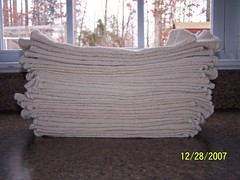
First, to update the progress on some of my sidebar goals, here is what we came up with for cloth napkins. I wanted to not have to worry about matching napkins with tablecloths and all other fancy-schmancy details that don't quite fit the casual nature of meals with seven children, so I looked for a ton of something all the same color. I had heard that lots of MOMYS use cute dishtowels for cloth napkins, so that got me to thinking outside of the box and allowed me to ditch my original plan of making napkins with my serger. (Whew!) The girls and I found off-white (who knew they came in that color?), unbleached cotton shop towels at Sam's Club, and thought they would be perfectly cute and quaint for napkins. They are not perfectly square or uniformly size (and neither are we) , but they are close enough, and the price was right. We paid about $12 for 100 towels. We love them!
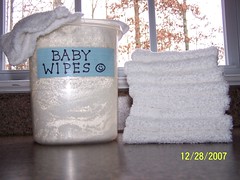
Next, we had always made our own baby wipes from paper towels, but I wanted to switch over to non-disposable ones. We had heard Moms talk of using the shop towels for baby wipes, so we considered those, but I didn't like the rough texture of them for delicate bottoms, so we settled on cheap wash cloths. We picked white because I wanted to wash them in hot water with the diaper loads and be able to see if they were really getting clean or not. They have been wonderful! Not at all too thick to wipe with (which I had wondered about), and they are very quick to throw together. They also don't dull my good butcher knife like cutting the paper towel rolls for the disposable ones did. We mix about a quart of water with two tablespoons of liquid soap, mix it together, and pour on top of as many washcloths as we can squeeze into our container. (We grate a bar of TN Farmgirl's soap, and pour two cups of boiling water over it, let it dissolve, and voila! Liquid soap that lives in a squeeze bottle in the bathroom closet, ready for making wipes!)
We also switched back to cloth diapers successfully. My first three were in cloth, but when I had four in diapers at once, I was given a large quantity of disposables and I switched to disposables and never looked back. Well, until now that is. I started making homemade cloth diapers with these instructions, but haven't been totally happy with them. They are thick and absorbent, very soft (made from old T-shirts), but the weave is so thick that pins refuse to go through them without a fight. If you decide to make them, I recommend adding the Snappi-able fabric, and using Snappi straps instead of pins. I would have continued to make more anyway (and buy some Snappi straps), except that someone (Thanks Anita!) just passed on to me a large bag of nice cloth diapers, and now I am freed from one more sewing project! (Yay!)
I also made (and totally fell in love with) wool soakers - diaper covers made from felted wool sweaters. WOW and double wow! I had NO idea the things would work so well. I will not bother with pictures and details, because Holly has already covered that well, but I will tell you that I am amazed that they work so well and are so sweet and cozy. I will never go back to any other cover after trying these! I made some wool longies (long pants-type diaper covers) and regular no-legs types. The wool longies are not the least bit scratchy (if you choose well when picking out which sweaters to use) and are so, so yummy-cute sticking out from under a little girls' dress in winter. They are also quick and easy to make! This is a great thing, as I priced pre-made ones online for upwards of $50 per pair! So there are three things now marked off my Switching-Over-To-Cloth list. Cool.
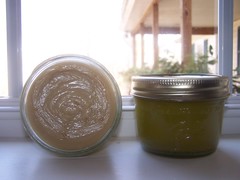
These jars contain some of our herb projects. The green one on the right is Healing Salve that we learned how to make from TN Farmgirl's Medicinal Herb Course. It is green because we used extra virgin olive oil for it. We use it for boo-boos instead of antibiotic ointment (it has several herbs known for their antibacterial/antifungal qualities), and for diaper cream in place of any kind of Vitamin D ointment. It is so much fun to slowly, one-by-one replace all those petroleum-based products with something HOME MADE! Although I usually hate the way this word is overused, I have found it to be empowering... I can really do this? Yes, I really can! Things like this remind me so much of the ideas in Mary Pride's The Way Home book... another few pieces of life brought back home. It is a good feeling.
The jar on the left contains homemade lotion/cream. We mixed yummy things like coconut oil and sweet almond oil with cocoa butter, herbs great for skin care like calendula, and essential oils like lavender and lime for that invigorating aromatherapy factor. It turned out great! We found the instructions from KeriMae at A Happy Home, and it really was as simple as she made it sound. My big girls really could have made this themselves - it was that simple. If you can make mayonnaise, you can make this... it is the same process (only without the eggs).
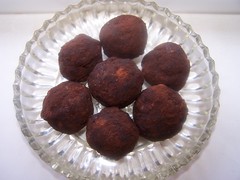
These yummy looking morsels are not truffles, no matter how hard I tried to convince my children. But they are close. Ever wonder how to get herbs into little children? Me too. Carla Lynne encouraged me to make what she calls "Herb Balls" to help get herbs into small children easily. She told me to powder the herbs I wanted included, then mix them with honey. Then, grind nuts, dried fruit, etc, and mix it all together. Make small balls, and roll them in carob powder, and refrigerate. She did not give me an exact recipe, so I can't give you one, but, I recommend the taste test plan. I tasted the mixture as I went along to know how much of which ingredients I wanted to add. The key to getting these yummy, I found, was to really powder the herbs well, so the texture doesn't stand out. They turned out great, and the flavor improves with a few days in the fridge. Now my little children beg for "those chocolate balls" and I have no trouble getting the herbs into those little bodies.

These little babies are the beginning of our making our own herbal cough drops. We got the recipe from TN Farmgirl's blog. I am not going to link to the exact post, because I want you to have fun digging through the archives and learning about all kinds of other herbal things on your way to this recipe. I will tell you this, though. They only have two ingredients, and making them was close to as fun as a taffy pull, if you have ever done that. They taste yucky. Horehound is a bitter herb, and it only is effective when bitter, BUT, my kids actually ate them OK. They said they weren't that bad. I did not try them, as horehound is contraindicated during lactation and pregnancy!

First we made the drops, then we rolled them in corn starch to keep them from sticking together. Next we wrapped them in freezer paper squares and put them in jars. They really work well for loosening chest congestion!
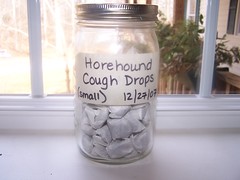
So that's the happenings around here. I hope you havesurvived enjoyed the journey through our random musings!
P.S. My Inbox is swamped, but I hope to catch up this week, so if you're waiting to hear from me, I'm hurrying! Thanks for being patient with me!
So, in the spirit of my seven year old's random musings, I share with you the recent happenings at our place.
Since we survived the flu, and Spring had not yet come, I decided to buckle down and try to get some projects wrapped up so I'd be free to play outside when the weather gets nice. Some of these were begun before the morning sickness began, only to be quickly shoved to the back burner during said morning sickness, then finally dragged back out and completed. In any case, what follows is not to be construed as, "Look what we did this week!" by any stretch of the imagination. It truly is a compilation of several months... and it truly is random. But I wanted to share because I'm excited, and... I have no one else to tell.
First, to update the progress on some of my sidebar goals, here is what we came up with for cloth napkins. I wanted to not have to worry about matching napkins with tablecloths and all other fancy-schmancy details that don't quite fit the casual nature of meals with seven children, so I looked for a ton of something all the same color. I had heard that lots of MOMYS use cute dishtowels for cloth napkins, so that got me to thinking outside of the box and allowed me to ditch my original plan of making napkins with my serger. (Whew!) The girls and I found off-white (who knew they came in that color?), unbleached cotton shop towels at Sam's Club, and thought they would be perfectly cute and quaint for napkins. They are not perfectly square or uniformly size (and neither are we) , but they are close enough, and the price was right. We paid about $12 for 100 towels. We love them!
Next, we had always made our own baby wipes from paper towels, but I wanted to switch over to non-disposable ones. We had heard Moms talk of using the shop towels for baby wipes, so we considered those, but I didn't like the rough texture of them for delicate bottoms, so we settled on cheap wash cloths. We picked white because I wanted to wash them in hot water with the diaper loads and be able to see if they were really getting clean or not. They have been wonderful! Not at all too thick to wipe with (which I had wondered about), and they are very quick to throw together. They also don't dull my good butcher knife like cutting the paper towel rolls for the disposable ones did. We mix about a quart of water with two tablespoons of liquid soap, mix it together, and pour on top of as many washcloths as we can squeeze into our container. (We grate a bar of TN Farmgirl's soap, and pour two cups of boiling water over it, let it dissolve, and voila! Liquid soap that lives in a squeeze bottle in the bathroom closet, ready for making wipes!)
We also switched back to cloth diapers successfully. My first three were in cloth, but when I had four in diapers at once, I was given a large quantity of disposables and I switched to disposables and never looked back. Well, until now that is. I started making homemade cloth diapers with these instructions, but haven't been totally happy with them. They are thick and absorbent, very soft (made from old T-shirts), but the weave is so thick that pins refuse to go through them without a fight. If you decide to make them, I recommend adding the Snappi-able fabric, and using Snappi straps instead of pins. I would have continued to make more anyway (and buy some Snappi straps), except that someone (Thanks Anita!) just passed on to me a large bag of nice cloth diapers, and now I am freed from one more sewing project! (Yay!)
I also made (and totally fell in love with) wool soakers - diaper covers made from felted wool sweaters. WOW and double wow! I had NO idea the things would work so well. I will not bother with pictures and details, because Holly has already covered that well, but I will tell you that I am amazed that they work so well and are so sweet and cozy. I will never go back to any other cover after trying these! I made some wool longies (long pants-type diaper covers) and regular no-legs types. The wool longies are not the least bit scratchy (if you choose well when picking out which sweaters to use) and are so, so yummy-cute sticking out from under a little girls' dress in winter. They are also quick and easy to make! This is a great thing, as I priced pre-made ones online for upwards of $50 per pair! So there are three things now marked off my Switching-Over-To-Cloth list. Cool.
These jars contain some of our herb projects. The green one on the right is Healing Salve that we learned how to make from TN Farmgirl's Medicinal Herb Course. It is green because we used extra virgin olive oil for it. We use it for boo-boos instead of antibiotic ointment (it has several herbs known for their antibacterial/antifungal qualities), and for diaper cream in place of any kind of Vitamin D ointment. It is so much fun to slowly, one-by-one replace all those petroleum-based products with something HOME MADE! Although I usually hate the way this word is overused, I have found it to be empowering... I can really do this? Yes, I really can! Things like this remind me so much of the ideas in Mary Pride's The Way Home book... another few pieces of life brought back home. It is a good feeling.
The jar on the left contains homemade lotion/cream. We mixed yummy things like coconut oil and sweet almond oil with cocoa butter, herbs great for skin care like calendula, and essential oils like lavender and lime for that invigorating aromatherapy factor. It turned out great! We found the instructions from KeriMae at A Happy Home, and it really was as simple as she made it sound. My big girls really could have made this themselves - it was that simple. If you can make mayonnaise, you can make this... it is the same process (only without the eggs).
These yummy looking morsels are not truffles, no matter how hard I tried to convince my children. But they are close. Ever wonder how to get herbs into little children? Me too. Carla Lynne encouraged me to make what she calls "Herb Balls" to help get herbs into small children easily. She told me to powder the herbs I wanted included, then mix them with honey. Then, grind nuts, dried fruit, etc, and mix it all together. Make small balls, and roll them in carob powder, and refrigerate. She did not give me an exact recipe, so I can't give you one, but, I recommend the taste test plan. I tasted the mixture as I went along to know how much of which ingredients I wanted to add. The key to getting these yummy, I found, was to really powder the herbs well, so the texture doesn't stand out. They turned out great, and the flavor improves with a few days in the fridge. Now my little children beg for "those chocolate balls" and I have no trouble getting the herbs into those little bodies.
These little babies are the beginning of our making our own herbal cough drops. We got the recipe from TN Farmgirl's blog. I am not going to link to the exact post, because I want you to have fun digging through the archives and learning about all kinds of other herbal things on your way to this recipe. I will tell you this, though. They only have two ingredients, and making them was close to as fun as a taffy pull, if you have ever done that. They taste yucky. Horehound is a bitter herb, and it only is effective when bitter, BUT, my kids actually ate them OK. They said they weren't that bad. I did not try them, as horehound is contraindicated during lactation and pregnancy!
First we made the drops, then we rolled them in corn starch to keep them from sticking together. Next we wrapped them in freezer paper squares and put them in jars. They really work well for loosening chest congestion!
So that's the happenings around here. I hope you have
P.S. My Inbox is swamped, but I hope to catch up this week, so if you're waiting to hear from me, I'm hurrying! Thanks for being patient with me!
Wednesday, December 26, 2007
What Else Are Ya Gonna Do?
If you have been itching to learn how to make your own herbal medicines and remedies... this is the time.
1) It's Winter, and the days are too dreary to be outside much
2) There will likely be extra opportunities to haveflu casualties case studies readily available
3) The price isright better than right now.
Run, don't walk over to Cheri's to buy her Medicinal Herb Course. This is the course I bought and studied to learn how to make herbal oils and salves, but there is also much more. An awesome recipe for Healing Salve is included in the Course, which is great for replacing both petroleum-based antibiotic cream (like Neosporin) and diaper rash ointment ~ we use it for both! Here's an excerpt from Cheri's site:
So, the course is on sale until December 31! With the purchase of the Course, you also get free mentoring from Cheri until the end of February! She is a wealth of knowledge in all things herbal, and I know you'll learn a lot from her.
What a great goal for the New Year ~ getting healthy ~ naturally. (I'll be posting my New Years' goals soon... as soon as I stop drooling over my new journal. Yum!) Are you thinking about some, too?
1) It's Winter, and the days are too dreary to be outside much
2) There will likely be extra opportunities to have
3) The price is
Run, don't walk over to Cheri's to buy her Medicinal Herb Course. This is the course I bought and studied to learn how to make herbal oils and salves, but there is also much more. An awesome recipe for Healing Salve is included in the Course, which is great for replacing both petroleum-based antibiotic cream (like Neosporin) and diaper rash ointment ~ we use it for both! Here's an excerpt from Cheri's site:
This simple, easy to follow course will teach you the basics of making your own herbal remedies. We will cover 10 easy to grow medicinal herbs, including some that commonly grow wild. The herbs included in this course are Calendula, Chamomile, Comfrey, Feverfew, Horehound, Lavender, Lemon Balm, Mullein, Plantain, and Red Clover. You will learn how to grow these herbs, how to harvest them, when to harvest them and how to use them in herbal remedies. You will learn their plant families, their medicinal properties and see a color picture of each one.
You will also learn how to make the most common herbal remedies! You will make a water infusion, a decoction, a hot oil infusion, a cold oil infusion, a syrup, a compress, a poultice, a salve and a tincture! I have even included a copy of my own research sheet that I use when studying a new herb.This course contains over 50 pages of material!
So, the course is on sale until December 31! With the purchase of the Course, you also get free mentoring from Cheri until the end of February! She is a wealth of knowledge in all things herbal, and I know you'll learn a lot from her.
What a great goal for the New Year ~ getting healthy ~ naturally. (I'll be posting my New Years' goals soon... as soon as I stop drooling over my new journal. Yum!) Are you thinking about some, too?
Thursday, December 13, 2007
Tinctures To Go
I hate memes. I do not mind reading them, mind you ~ it is fun to read other folks' ~ but I know me... if I started doing them, I would feel pressured by the things and feel as if I had to do it every week. I have enough real responsibilities without my adding imagined ones. All of that is to say that had I been doing the Works For Me Wednesday meme, and had today actually been a Wednesday, this is the sort of thing I would post.
Mr. Visionary was feeling under the weather last night when he came home from the old grind work. He had a stuffy nose, his sinuses were swollen and stuffy feeling, and his head was aching. He had felt fine until about mid afternoon, so after interrogating questioning him about his day and noting nothing out of the ordinary, I smelled a rat and figured a virus was to blame. I doused dosed him with tinctures, and sent him to bed.
When he awoke stuffy again, I gave him another tincture dose, but realized that, Dads not always having the luxury of staying home when they're feeling poorly, he'd be leaving for work in a few minutes. It was then that an idea struck me, a second-best idea, (the first-best was having Dad stay at home), in the form of portable tinctures.
Dunt dunt dunt dun... (How does one spell that drumroll sound the boys are always making?)
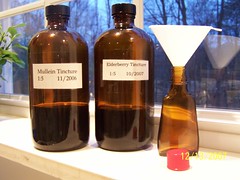
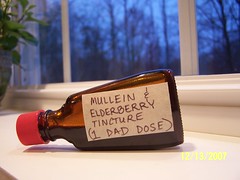
Cool, huh? Now all Dad has to do is mix this pre-measured dose with a little water to make it easier to get down, and voila! Healthy medicine to go.
I save vanilla bottles for just this purpose... the amber colored glass is perfect for maintaining the quality of your tinctures, and I won't mind if they get lost or broken.
Works for me, even if it isn't Wednesday.
Mr. Visionary was feeling under the weather last night when he came home from
When he awoke stuffy again, I gave him another tincture dose, but realized that, Dads not always having the luxury of staying home when they're feeling poorly, he'd be leaving for work in a few minutes. It was then that an idea struck me, a second-best idea, (the first-best was having Dad stay at home), in the form of portable tinctures.
Dunt dunt dunt dun... (How does one spell that drumroll sound the boys are always making?)
Cool, huh? Now all Dad has to do is mix this pre-measured dose with a little water to make it easier to get down, and voila! Healthy medicine to go.
I save vanilla bottles for just this purpose... the amber colored glass is perfect for maintaining the quality of your tinctures, and I won't mind if they get lost or broken.
Works for me, even if it isn't Wednesday.
Friday, December 7, 2007
Sickness Season
Since it appears to be that time of year again, when viruses are running rampant, and lots of folks are succumbing, I've been feeling led to get back on the wagon as far as doing my part to keep us healthy. Also, my dear friend Carla Lynne has also just been through a major illness, and her exhortation to WASH YOUR HANDS startled me awake again. I hadn't realized how lax my efforts at building our family's immunity had become.
But, as they used to say on the G.I. Joe cartoon I watched as a kid, "Knowledge is half the battle... Yo Joe!" Now that I know, I'm redoubling my efforts, and restudying my own homework to refresh myself. I am posting a link to an old study I did called Battling Illness Naturally:Prevention for your benefit, and mine.
Now I won't have to keep digging in the Archives every time I want to read it. :)
But, as they used to say on the G.I. Joe cartoon I watched as a kid, "Knowledge is half the battle... Yo Joe!" Now that I know, I'm redoubling my efforts, and restudying my own homework to refresh myself. I am posting a link to an old study I did called Battling Illness Naturally:Prevention for your benefit, and mine.
Now I won't have to keep digging in the Archives every time I want to read it. :)
Friday, October 5, 2007
I Actually Won Something!
You know that last post about the otoscope contest, well...I actually WON one!
Cool, huh?
Go see, and see some other neat articles that explain how to use them and why...HERE.
By the way, I am still planning to get back here and answer Lynne's questions, but I've been swamped. Mr. Visionary and I are speaking at a Missions Conference for four nights beginning Sunday and I have been frantically putting together a Power Point presentation, plus getting all of us ready to go. Pray for us and the Work, if you think of it! We'd be grateful.
Meanwhile...I'll be back as soon as I can!
Cool, huh?
Go see, and see some other neat articles that explain how to use them and why...HERE.
By the way, I am still planning to get back here and answer Lynne's questions, but I've been swamped. Mr. Visionary and I are speaking at a Missions Conference for four nights beginning Sunday and I have been frantically putting together a Power Point presentation, plus getting all of us ready to go. Pray for us and the Work, if you think of it! We'd be grateful.
Meanwhile...I'll be back as soon as I can!
Friday, December 29, 2006
Dropping Like Flies
So my girlfriend calls today, checking on our new cow, and casually asking if we had received her Christmas gift, “You know, the one I left you last week”. When two girlfriends and their children were here for an impromptu tea party, our collective children enjoyed themselves, tea-ing, partying and sundry other giggle-inspiring activities, while the Mommies chatted and did not spell out our words.
We have all experienced the phenomena when your company leaves and you find out that the children were all doing something they oughtn’t - in that order. Sometimes you find out right away… sometimes it takes a few days for all the facts to come out. Sometimes the children know better…sometimes they are clueless. The game that has small parts that they weren’t supposed to have out with toddlers, the weapons when our peace-loving friends join us, the sharing of germs…
This time it took a few days (and a few kids) before I found out that our Christmas gift was the gift that keeps on giving. Seventeen loads of laundry later due to a front door/backdoor illness, I am wishing I had not spoken so soon. I mentioned to the gifter that our family was not hit too hard by this virus – only three had had it, with two days between each onset. At dinner we had two more casualties.
Yes, as a matter of fact, we did get that gift. As frugal as I tend to be, I will resist the urge to regift this time. Instead, with a blanket announcement that our family will be conspicuously absent from church this week, we are preparing to ring in the New Year from the sick beds on the couch.
Out with the old…eh?
Thursday, December 14, 2006
Learning Curve
Deep sigh.
It's over. I was truly dreading it, knowing that the dispersing of such information could very well cause us to be the laughing stock of the church, I didn't want to tell.
When you go to church with almost all farmers, especially folks who were raised on a farm, eating, sleeping, breathing farm life, you just know they giggle at you when you make mistakes. A dear sister from church who runs a feed store has visibly reddened and had to exercise tremendous amounts of self control over some of my questions to her. She's a patient woman. She manages to maintain her composure enough to educate me even when her coffee is attempting to come out of her nose.
But it didn't happen. Actually, it never has. As much as I anticipate it, it never actually occurs-they never laugh. Instead, our revealing the newest of ourdumb mistakes educational experiences simply spurs our friends' stories of their early years on their own farms, when they were just learning .
Case in point: we were recently expecting our Jersey dairy cows to calve. I was joyfully expecting their arrival, and the ensuing flood of milk, butter, ice cream, cream cheese, yogurt, ice cream, kefir, ricotta and ice cream that we would have once more. Did I mention ice cream? (Our children used to have asthma and ezcema, and can't have pasteurized milk, so we've been without dairy during the dry period.)
When we recently announced that we found out our cows are not even pregnant, lots of folks were disappointed with us, but they assured us that it was a common mistake. Not having them checked by the vet after breeding to be sure they were pregnant is an ommission that apparently everyone has made. But only once.
'Well, I guess you won't be making that mistake again!'
No, I can assure you, we will not make that mistake again.
We'll have a list of plenty of others to work on...
It's over. I was truly dreading it, knowing that the dispersing of such information could very well cause us to be the laughing stock of the church, I didn't want to tell.
When you go to church with almost all farmers, especially folks who were raised on a farm, eating, sleeping, breathing farm life, you just know they giggle at you when you make mistakes. A dear sister from church who runs a feed store has visibly reddened and had to exercise tremendous amounts of self control over some of my questions to her. She's a patient woman. She manages to maintain her composure enough to educate me even when her coffee is attempting to come out of her nose.
But it didn't happen. Actually, it never has. As much as I anticipate it, it never actually occurs-they never laugh. Instead, our revealing the newest of our
Case in point: we were recently expecting our Jersey dairy cows to calve. I was joyfully expecting their arrival, and the ensuing flood of milk, butter, ice cream, cream cheese, yogurt, ice cream, kefir, ricotta and ice cream that we would have once more. Did I mention ice cream? (Our children used to have asthma and ezcema, and can't have pasteurized milk, so we've been without dairy during the dry period.)
When we recently announced that we found out our cows are not even pregnant, lots of folks were disappointed with us, but they assured us that it was a common mistake. Not having them checked by the vet after breeding to be sure they were pregnant is an ommission that apparently everyone has made. But only once.
'Well, I guess you won't be making that mistake again!'
No, I can assure you, we will not make that mistake again.
We'll have a list of plenty of others to work on...
Saturday, November 18, 2006
Battling Illness Naturally (Part Two) Prevention
We've heard it a thousand times, 'An ounce of prevention is worth a pound of cure'. But when it comes to being sick, or worse, having our kids sick, or even worse yet, having all your kids sick at once, this prescription is as good as gold.
Exposure to bacteria and viruses is not the cause of illness. We are exposed to harmful germs daily. Our bodies' response to them is what determines if illness will occur. Some measures we take are about avoiding exposure, and others focus on building our immune response. The two go hand-in-hand.
Starting with those stratagems which are easiest to implement, following are some of the measures we employ in our quest to prevent illness as much as possible:
- Stay well hydrated. Drink plenty of water to keep mucous membranes wet. Wet noses (not necessarily runny), wet eyes, and a moist mouth will repel germs, whereas dry ones allow the germs to stick like glue. If you are waking with a sore throat and dry cracked lips, you are not drinking enough. (The recommended amount to drink is half your body weight in ounces of water daily, which for my Little Napoleon would be about three ounces a day. Grin.)
- Exercise daily. (Please don't ask me if I really do this.) The lymph system has no pump like the circulatory system, so the only way it can move the good stuff (lymphocytes and antibodies) and the bad stuff (bacteria and viruses) where they need to go is through our muscles contracting and pumping it around. Hence, folks who exercise have higher immune function.
- Get fresh air daily. (Sounds like a no-brainer, but for homeschool Moms, it is sometimes a challenge.) Get yourself outside, and get fresh air inside as much as possible. Open windows-even in winter for a short time. Stale air is full of toxins, which stress the body's systems. Stale air is typically very dry as well, which goes back to point number one about dry mucous membranes.
- Wash hands frequently and properly. Use hot water and soap, and keep rubbing for 20 seconds. This is about as long as it takes to sing the first verse of Amazing Grace, or if you're Doodle, the first line three times over. The hot water and soap will help wash off the germs, but you don't want to kill them. Antibacterial soaps are a leading cause of antibiotic resistant bacterial strains of germs. Don't use them if you want to be healthy. What doesn't kill them makes them stronger, and since we don't wash our hands under a microscope, we don't want to take chances.
- Bathe properly. That means not too much bathing, and not too much soap. In studying, I found that decreased exposure to bacteria may be spurring the rise of modern-day illnesses such as asthma, allergies and auto-immune diseases. Also, our skin has an acidic oily layer that is the biggest chemical barrier to infections, because it is inhospitable to most harmful germs. When this layer is washed off with soap, it does us no good. So wash your hands with soap, but try to avoid it on the rest of the body.
If you can stomach it, you can let them eat...well, you can read it yourself here.
- Get enough rest. Tired bodies have tired immune systems. If you are worn down, you will be more likely to get sick. I try to be proactive about this by not allowing us to be over-extended. Instead of waiting until we are already coming down with something to rest, I make it a priority all the time. Good, deep sleep allows our bodies to release interferon, a powerful immune-enhancing compound that is especially helpful with fighting viral infections.
- We avoid antibiotics at all costs. Anti means against, and biotic means living organisms...these things kill living organisms-the good and the bad. (Until I started studying immunity, I had no idea how important 'good bacteria' were. I will explain more about this later.) When something does the work for you, it makes you weaker. Every time we use antibiotics, our bodies lose an opportunity to grow stronger. Studies also show that for a normally healthy person, the use of antibiotics lengthens the duration of illness, and the likelihood of recurrence.
- We drastically cut our intake of sugar. We don't drink juice, soda, Kool-Aid, etc. Studies have shown that after ingestion of even a teaspoon of sugar, immune function is depleted for up to six hours. This goes for even healthy sugars like raw honey, sucanat, real maple syrup,and even...fruit juice. Whole fruits do not have the same effect on immunity. For us, this looks like not serving pancakes with maple syrup before church or on Town Day, when we will be exposed to a lot of new germs.(Not to mention how it helps Little Napoleon sit still in church better.)
- Dietary Supplements- these are things we include in our everyday diet to strengthen our immune systems:
- Vitamins-We do not use vitamin supplements, only whole foods. Studies have shown isolated nutrients (and especially synthetic ones) do more harm than good.
- Cod liver oil- Nourishing Traditions says it confers 'resistance to infectious disease in children'. We buy it lemon-flavored, and there is no special way to take it...just chug a spoonful with dinner. This has been instrumental in curing one of our children of asthma.
- Virgin coconut oil- The Coconut Oil Miracle says that the fatty acids found in coconut are powerful natural antibiotics, killing bacteria like streptococcus and staphylococcus. Besides being the only oil outside of butter that we use in cooking, we also put it in smoothies for snacks and hurry-up breakfasts. Another yummy way to supplement with this is to melt a spoonful in a cup of hot tea or hot chocolate.
- Raw garlic-this Italian girl is thrilled that garlic is part of a healthy lifestyle! We eat it regulary in salad dressing, pasta sauce, dips, etc. Our favorite way to have it is on pasta tossed with extra virgin olive oil, salt, pepper with raw garlic put through the garlic press. Even the Littles eat it this way a smidge, and the big kids like it with plenty of garlic, (although no one likes as much as Mom!). Garlic can stimulate the activity of the white blood cells, which attack foreign organisms (viruses, bacteria, and yeast). Also, garlic increases the activity of the T-helper cells (immune cells which are central to the activity of the entire immune system). Dragon breath for a good cause!
- Elderberry Extract- we take our homemade Elderberry syrup every day during cold and flu season. Studies about elderberry extract have proven it to offer strong protection against respiratory viral infections. Here are instructions for making it yourself, or you can buy Sambucol. Elderberry has no contraindications, and can be taken continually (unlike Echinacea) without harming immune response.
Throughout my studies, and now, my experience, the most important thing I have come across to support and strengthen the immune system is healthy bacteria in our digestive systems! I cannot stress this enough. The good bacteria in our digestive tract kills the harmful germs we come into contact with while they are in our digestive tract, before they enter our bloodstream. The lack of healthy bacteria in our bodies these days is why food poisoning is so rampant. E. Coli is naturally occurring in our bodies-it is just when it gets out of balance that it wreaks havoc. I found that strong immunity depends upon the bacteria in the digestive system being in balance, with the 'good' bacteria outnumbering the 'bad'. Everything under the sun kills the good and causes the bad to proliferate, especially stress, conventional farming methods, and the over-processed, high-sugar content of the standard American diet.
In organic farming, the healthy bacteria we need in our systems are naturally on the fruits and vegetables we grow. Modern farming practices kill the bacteria, causing us to be way under-supplied with the good bacteria or 'friendly fauna'. Thus, our need to supplement our diets with these bacteria. A healthy whole foods diet will help to keep the bad bacteria in check, but we have to be sure to eat the good. How we do that is by making and consuming traditional lactic-acid fermented foods such as yogurt, kefir, sauerkraut, and old-fashioned lacto-fermented pickles. (This dietary change has also been instrumental in curing one of our children of asthma. Thank you, Father!)
We eat at least one of these foods daily (it only takes a smidge) to keep those bacteria in balance. A yogurt shake, a tablespoon or two of sauerkraut with our sandwich at lunch, a few pickle slices with dinner...it is very easy to do. If you want to know more about the effect of the digestive system on immunity, read Restoring Your Digestive Health by Jordan Rubin. If you want recipes and instructions for making these lacto-fermented foods, read Nourishing traditions by Sally Fallon. They are truly simple to make-needing nothing more than a knife, a jar, some salt, some water and a vegetable. The kids have been talking about posting a blog tutorial about making lacto-fermented vegetables, so we may do that soon.
In closing, I just want to state that YHWH (God's name in Hebrew) is sovereign. He alone controls whether we and our families will experience illness. Knowing that He expects us to be faithful stewards of the health that He has bestowed, these are the measures that we have been led to take.
Well, these and the old stand-by:
'You can pick your friends, and you can pick your nose, but you can't pick your friend's nose.'
At least not while he's sick.
P.S. If you haven't already, you may want to read Battling Illness Naturally Part One ~ The Why.
Tuesday, October 31, 2006
Blessed Rest
He said to do it. He even blessed it. Back before the Fall and before the Law, He told us to do it. His doing it Himself convinced me that it was something I should be doing. Yet I struggle with observing the Sabbath. There is a battle storming between my flesh and spirit…
Rationally I am convinced that I need to rest on the Sabbath. I am fully aware of the physiologic benefits of cycling through periods of exertion and rest. It makes us more efficient, and we are healthier when alternating our working and resting. I truly believe God planned this for our best good. For my best good.
Then why the struggle?
In the midst of the day’s work, I vacillate between sincerely desiring to ‘work heartily as unto the Lord’ and having my body piercingly scream for rest. I need stillness. In the midst of the pressures and stress of daily living my spirit quietly whimpers for a reprieve. I need peace. In the flurry of activity a fleeting, over-the-shoulder glance at my Bible does not suffice. I need intimacy.
When the preparation day arrives, I am not ready. I do not want to stop striving toward my own purposes. Although His yoke is easy and His burden is light my To-Do list is never finished and my labor never completed. In my flesh there is no desire to leave off my agenda and prepare for that to which I know He is calling me. He whispers while my list shrieks. On the Sabbath, my list mocks me, taunting me with the alleged ‘wasted time’.
I have to remind myself (a thousand times a day if needed) that this is a day blessed and sanctified by Him for me. My Jesus is Lord of this day, and whatever it takes to enter into this small taste of that forever-rest is worth doing. There is no righteousness attached to this day-my Lord took care of my righteousness once and for all at the Cross.
But the blessings are infinite…Stillness. Peace. Intimacy. Rest.
Tuesday, October 17, 2006
Tincture Time!
I promised a post on making herbal tinctures, and here it is!
Everybody's doing it. The more folks learn about natural health, and taking seriously the stewardship of their health, the more folks are learning about herbal medicine. Making your own herbal medicine is combining health stewardship and financial stewardship. Even Martha (who surely doesn't view stewardship from a biblical worldview) is doing it. (As much as Mr. Visionary 'respects' Martha Stewart, if he sees this, I'll have to break out my ginger tincture to help settle his stomach. "You put a link to who???")
Most of the time, when I need herbal medicine for my family, I choose alcohol tinctures for several reasons. First, they make the chemical constituents of the herbs easier for our bodies to assimilate. (Just like you wouldn't eat nails if you wanted to increase your iron levels. It just doesn't work.) It is the same with herbs. Not all the good stuff in the herbs can be extracted through digestion. Second, alcohol is the strongest solvent that can extract a major portion of the plant constituents without harming its properties. Also, they are easy to make (read that: not labor intensive), keep forever (about five years when stored properly), and they don't take up tons of space (compare a cough syrup bottle for the tincture to a bag of cotton candy for the bulk dry herb).
You can make tinctures with a different menstruum (the liquid medium) such as vinegar or glycerine, but the alcohol medium makes the tincture stronger. Also, Mr. Visionary wouldn't get near anything made with vinegar and the glycerine method is much more involved.
How you make them is actually very simple. Powder the herb, add alcohol, and let it sit a while. Then take the alcohol back out, and it is a tincture. The timing and measurements are the only parts that are slightly more complicated.
I buy my herbs in bulk in the largest form possible (i.e. sticks or pieces of root herbs, whole leaves or flowers of herbs, etc.), then powder them myself in the blender. This is because the chemical constituents last longer in a whole form rather than a powdered form. If you do not have strong blender, then it is perfctly fine to buy your herbs already powdered, just make sure they are fresh.
Here is how we recently made an Elderberry tinture and then turned it into syrup (you'll flip when you see how easy it is):
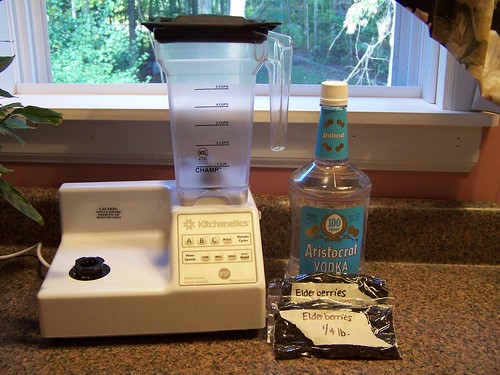
Step One: Gather supplies. We use 100 proof alcohol (v*dka is said to have very little taste) because it has the exact 50/50 ratio of water to alcohol that you need for your menstruum. (Some of the plant constituents need water to extract and some need alcohol, and the ratio matters.) The proportions of herb, alcohol and water we use will make a standardized extract that will have a specific amount of that herb's healing ingredients. This makes following dosage guidelines more accurate, and you know that when you make the same tincture the next time, it will have the same strength.
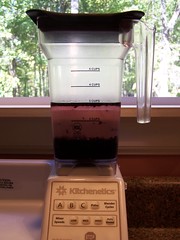
Step Two: Measure ingredients. For soft herbs like Elderberries (they are a little harder than raisins) you will need to blend the herb and v*dka at the same time without powdering the herb first. (You will need 1/4 pound of dried herb for 16 ounces of alcohol to make a standardized tincture.) Here are some very good directions for making a tincture with instructions for figuring out your measurements.
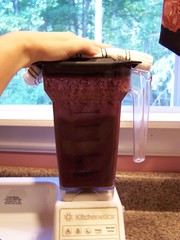
Step Three: Blend Well. Blend the herb and alcohol until thoroughly combined. It will be thick and the berries should be as completely dissolved as your blender can get them. (Just a side note: this can also be done with a simple mortar and pestle...you don't have to have a spectacular blender, it just saves time.)
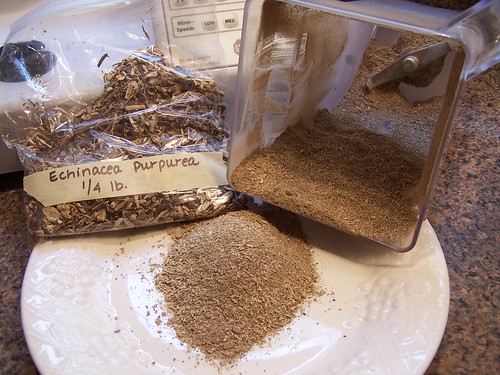
When you use hard dried herbs (like this echinacea) it works best to powder the herb in the blender before you add the alcohol (at least that is what we've found).
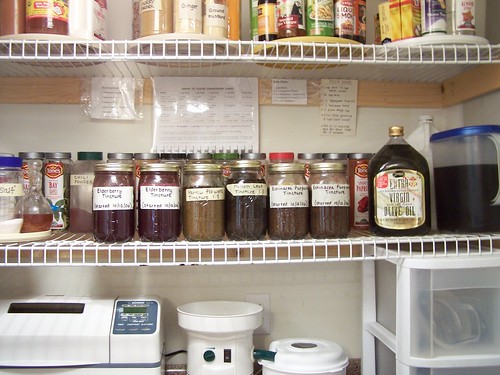
Step Four: Macerate (or soak). Now, pour the mixture into a jar with tight-fitting lid and stick it in a cabinet or pantry (somewhere in the dark). Even though it has to sit for two weeks (at least) you will want it some place easily accessible (and easy to remember) because it needs to be shaken every day. Shake it every day to get it well mixed (the herb will settle to the bottom of the jar). While it needs at least two weeks, the longer it sits, the better it will be. Some (especially Asian herbalists) believe it is better to leave them to macerate for 6 weeks or longer. However, I have read that after six months, the alcohol will no longer extract constituents from the herb.
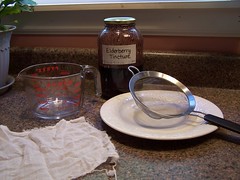
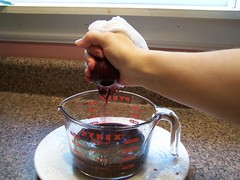
Step Five: Strain the liquid (two weeks later). You need something to help you strain all that smushed-up herb back out of the mixture. We use a metal mesh strainer lined with cheesecloth (wet the cheesecloth first). Pour the mixture into the cheesecloth lined strainer, and let as much liquid as you can strain through on its own. Do small amounts at a time. Then, gather up the cheesecloth and gently squeeze the remaining liquid out of the herb mixure. Be careful not to squeeze too hard or you will burst the cheesecloth and have to start all over. However, get as much liquid as you can squeezed out, as this is the richest part of your tincture, and you don't want to waste any.
Step Six: Bottle and store your tincture. Now your tincture is complete, and you can bottle it for future use. It will keep best if stored in dark jars (blue or amber). Make sure you label your jars!
Now, for how to make the syrup:
I learned that I can mix equal parts of an herbal tincture with either honey or maple syrup to make a simple syrup. I chose not to use honey in case I ever needed to give some to the baby. So, I mixed equal parts of my elderberry tincture and real maple syrup. When using this syrup, I double the standard dosage. Typically, during an illness, I keep the sick person far away from any sugar. Shonda Parker (author of Mommy Diagnostics) taught me that any sugar (even healthy natural sugars like juice, sucanat or honey, etc.) decreases immune function for up to four hours after ingestion. But since we use Elderberry syrup primarily for prevention, and since the dosage is so small (for children: 30 drops or ~1 teaspoon per day) I determined that it was a small price to pay for the ease of getting herbs into my children. You see, this stuff tastes like candy-it is delicious! My children call it blueberry juice'.
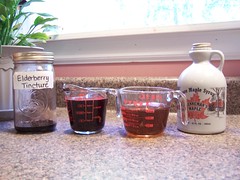
'Blueberry juice' recipe: equal parts elderberry tincture and maple syrup. Store in the refrigerator.
There are tons of sites online that give more information about making herbal medicine, and I have learned some there. Some sites I use when researching herbs are:
this one for learning about the usage of certain herbs,
this one for learning how to make different forms of herbal products,
and this one for buying herbs and essential oils in bulk.
Several books that have taught me a lot are:
Mommy Diagnostics by Shonda Parker
Herbal Antibiotics by Stephen Harrod Buhner
The Complete Woman's Herbal by Anne McIntyre.
Have fun making your own medicine. (Although I hope you won't be needing it!)
Subscribe to:
Posts (Atom)